

Window Tinting in Carver Heights, FL gives drivers several film choices, and those choices can affect heat rejection, privacy, glare, UV protection, clarity, and how the vehicle looks. Two tint films can appear almost identical from outside while providing very different results inside the cabin.
305 Auto Customs installs STEK ceramic window tint for cars, trucks, SUVs, luxury vehicles, Teslas, and work vehicles. We serve drivers from Broward County, FL, Miami-Dade County, FL, Davie, FL, Miami, FL, and surrounding South Florida communities. Carver Heights is a neighborhood in Deerfield Beach, FL within Broward County, making window tint a common consideration for drivers who spend time under strong South Florida sun.
When people talk about “window tint grades,” they may be referring to film construction, heat rejection, clarity, shade, or the product series. There is not one universal grading scale that labels every automotive film as Grade 1, Grade 2, or Grade 3.
A better comparison looks at what the film is made from and what its published specifications show.
For STEK automotive tint, that means looking at carbon, nano-ceramic, and graphene-infused ceramic film options.
Table of Contents
- What Window Tinting in Carver Heights, FL Film Grades Really Mean
- Carbon vs Ceramic vs Graphene Ceramic Tint
- STEK ACTION+ Carbon Window Tint
- STEK SMART+ Nano-Ceramic Window Tint
- STEK NEX+ Graphene-Infused Ceramic Tint
- Film Grade Comparison Chart
- Does Darker Tint Mean Better Heat Rejection?
- Understanding IRER, TSER, and VLT
- Which Film Grade Works for Florida Heat?
- Which Film Grade Works for Privacy?
- Which Film Grade Works for Clear Visibility?
- UV Protection Across Film Types
- Choosing Tint for Front Windows
- Choosing Tint for Rear Windows
- Florida Window Tint Limits
- Choosing Film for Cars, SUVs, Trucks, and Teslas
- Full-Car Tint vs Two-Window Tint
- Why Professional Tint Installation Matters
- Window Tinting for Carver Heights, FL Drivers
- Window Tint FAQs
- Sources
What Window Tinting in Carver Heights, FL Film Grades Really Mean
Drivers comparing Window Tinting in Carver Heights, FL may hear terms such as regular tint, carbon tint, ceramic tint, nano-ceramic tint, or graphene ceramic tint.
These terms describe film construction more clearly than a simple low, middle, or high grade label.
Film construction can affect:
- Heat rejection
- Infrared energy rejection
- Solar energy rejection
- UV protection
- Glare reduction
- Optical clarity
- Color stability
- Privacy
- Available darkness levels
- Long-term appearance
STEK divides its LUNARAY automotive tint line into three main series:
- ACTION+ carbon tint
- SMART+ nano-ceramic tint
- NEX+ graphene-infused ceramic tint
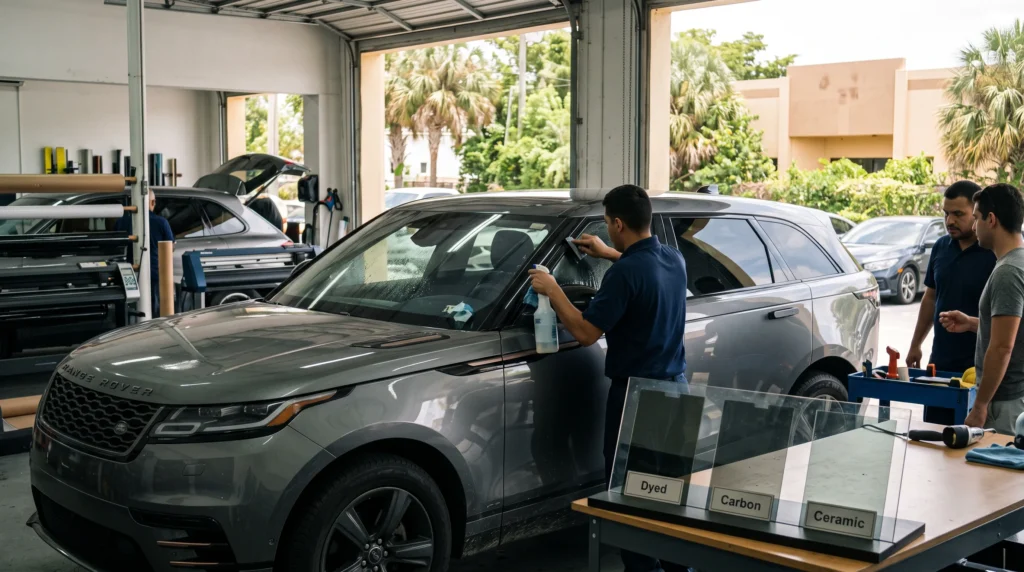
Each series comes in several visible light transmission levels.
That means drivers can compare both the film technology and the shade.
Carbon vs Ceramic vs Graphene Ceramic Tint
The easiest way to compare window tint grades is to start with construction.
Carbon Window Tint
Carbon window film uses carbon material to create its color and solar-control characteristics.
STEK describes ACTION+ as a nano-carbon film with a neutral appearance, UV rejection, glare reduction, and heat control.
Carbon tint may fit a driver who wants:
- Privacy
- Darker glass
- UV protection
- Glare reduction
- Some heat rejection
- A neutral charcoal appearance
Nano-Ceramic Window Tint
Ceramic tint uses ceramic particles to handle more solar and infrared energy.
STEK SMART+ is a nano-ceramic window film.
Compared with carbon film, SMART+ is designed to provide stronger heat rejection while maintaining clear outward visibility.
Ceramic tint can make sense for drivers who spend long periods in the sun or leave their vehicles outdoors during the day.
Graphene-Infused Ceramic Tint
STEK NEX+ combines ceramic film construction with graphene-infused technology.
STEK positions NEX+ above SMART+ for heat rejection.
This type of film may appeal to drivers who place cabin heat control high on their list while still wanting UV protection, glare reduction, privacy, and several shade choices.
STEK ACTION+ Carbon Window Tint
ACTION+ is STEK’s carbon tint series.
STEK lists ACTION+ in several VLT levels, including:
- ACTION 05
- ACTION 15
- ACTION 20
- ACTION 35
- ACTION 50
- ACTION 80
The number in the product name generally corresponds to the shade family, though the published measured VLT may differ slightly.
STEK states that ACTION+ blocks 99% of UV rays across its listed shades.
Published ACTION+ specifications also show total solar energy rejection reaching the 50% range on darker films.
This makes ACTION+ a film worth comparing when the driver’s goals include appearance, privacy, glare control, UV protection, and some heat reduction.
For Window Tinting in Carver Heights, FL, carbon tint may suit someone who is more focused on shade and privacy than getting the strongest heat rejection available from the STEK lineup.
STEK SMART+ Nano-Ceramic Window Tint
SMART+ moves into nano-ceramic film construction.
STEK lists SMART+ in several VLT levels:
- SMART 05
- SMART 15
- SMART 20
- SMART 35
- SMART 45
- SMART 70
STEK reports that SMART+ can block up to 87.5% of infrared light, depending on how the measurement is expressed and which specification is being reviewed.
Its current film data lists IRER ratings in the mid-50% to low-60% range across listed shades.
STEK also reports:
- Up to 60% solar energy reduction
- 99% UV rejection
- Glare reduction reaching 92% on its darkest listed film
- Limited lifetime warranty coverage against listed film failures
A lighter SMART+ film can still provide ceramic heat-control properties.
That point matters for drivers who want Window Tinting in Carver Heights, FL without making every window extremely dark.
STEK NEX+ Graphene-Infused Ceramic Tint
NEX+ is STEK’s graphene-infused ceramic film line.
Available shades listed by STEK include:
- NEX 05
- NEX 15
- NEX 20
- NEX 35
- NEX 45
- NEX 70
- NEX 85
STEK’s current published data shows 99% UV rejection across those listed NEX+ films.
The company also publishes IRER figures ranging from the mid-30% range on its very light NEX 85 film to the mid-60% range on darker films.
Published TSER figures reach into the 60% range on darker NEX+ shades.
NEX+ is aimed at drivers who place more emphasis on heat control.
That can make it worth discussing for South Florida vehicles that spend long periods outdoors or travel throughout Broward County, FL and Miami-Dade County, FL during hot daytime conditions.
Film Grade Comparison Chart
Here is a simple way to compare the three STEK film types.
| Film Series | Construction | UV Rejection | Heat Control | Privacy Options | Light Shade Options |
|---|---|---|---|---|---|
| STEK ACTION+ | Nano Carbon | 99% | Good | Yes | Yes |
| STEK SMART+ | Nano Ceramic | 99% | Higher than ACTION+ | Yes | Yes |
| STEK NEX+ | Graphene-Infused Ceramic | 99% | Highest of these STEK series | Yes | Yes |
The film that makes sense for your vehicle depends on more than where it sits in the product lineup.
Your normal driving time, vehicle glass, privacy goals, Florida law, and preferred appearance should also be considered.
Does Darker Tint Mean Better Heat Rejection?
No. Darkness and heat rejection are separate measurements.
A darker film allows less visible light into the vehicle.
That can give you:
- More privacy
- A darker appearance
- More visible glare reduction
It does not automatically mean the film rejects more infrared or total solar energy.
A lighter ceramic film can provide stronger heat rejection than some darker carbon films.
This is one of the biggest reasons drivers comparing Window Tinting in Carver Heights, FL should look beyond tint percentage alone.
Ask which film series is being installed, not just whether you are choosing 15%, 20%, or 35%.
Understanding IRER, TSER, and VLT
Window film specification sheets contain several measurements.
Knowing what they mean makes film grades easier to compare.
VLT
VLT stands for Visible Light Transmission.
It measures how much visible light passes through the glass and film.
A higher VLT allows more visible light through.
A lower VLT allows less visible light through and usually appears darker.
IRER
IRER stands for Infrared Energy Rejection.
STEK states that it follows the IRER reporting method used by the International Window Film Association.
IRER helps describe how a film handles infrared energy across a defined range.
This can be useful when comparing heat-control films.
TSER
TSER stands for Total Solar Energy Rejected.
TSER looks at a broader portion of solar energy instead of only one part of the spectrum.
When heat is your concern, comparing TSER and IRER can tell you more than VLT alone.
Which Film Grade Works for Florida Heat?
For drivers focused on heat, ceramic film deserves a closer look.
STEK states that its SMART+ ceramic tint provides more heat rejection than its carbon tint.
NEX+ sits above SMART+ in STEK’s lineup for solar and infrared heat control.
That creates a simple progression:
ACTION+ Carbon → SMART+ Ceramic → NEX+ Graphene-Infused Ceramic
This does not mean every driver needs the highest film series.
Someone who parks in a garage and drives short distances may have different priorities from someone whose vehicle sits in direct sun all day.
For Window Tinting in Carver Heights, FL, tell the installer how much time your vehicle spends outdoors and when you normally drive.
Which Film Grade Works for Privacy?
Privacy depends heavily on VLT.
A lower VLT lets less visible light through the glass.
This makes the cabin harder to see from outside compared with a lighter film.
STEK provides dark shades across ACTION+, SMART+, and NEX+.
That means privacy does not require choosing one construction type.
You can select carbon or ceramic film and still choose from darker shade families.
Florida law limits how dark certain windows can legally be, so privacy choices should be made window by window.
Which Film Grade Works for Clear Visibility?
Film construction and manufacturing can affect clarity.
STEK promotes optical clarity across its automotive tint lineup.
SMART+ and NEX+ are made for drivers who want stronger heat control without relying only on very dark glass.
This can be useful when a driver wants a lighter film but still cares about solar heat.
Night driving should also be part of the decision.
A very dark film can make outward visibility harder in dim parking lots, poorly lit streets, and rainy conditions.
Drivers researching Window Tinting in Carver Heights, FL should think about daytime and nighttime use before settling on a shade.
UV Protection Across Film Types
STEK lists 99% UV rejection for ACTION+, SMART+, and NEX+ shades shown on its current product pages.
That means moving from carbon to ceramic is mainly about factors such as heat rejection and film construction rather than getting UV protection only at the higher tier.
UV-blocking film can reduce UV exposure reaching occupants and interior materials through treated glass.
Seats, dashboards, trim, leather, and other cabin surfaces receive sunlight throughout the life of the vehicle.
Choosing Tint for Front Windows
Florida regulates the windows forward of or next to the driver’s seat.
Under Florida Statute 316.2953, authorized sunscreening material on these windows must have:
- At least 28% visible light transmission
- No more than 25% visible-light reflectance
The rule applies when the material is installed and tested on the vehicle glass.
That last part matters.
Factory automotive glass already affects light transmission, so the film’s listed VLT is not always the exact reading of the finished window.
Ask about the completed glass-and-film reading when planning Window Tinting in Carver Heights, FL.
Choosing Tint for Rear Windows
Rear windows have separate Florida rules.
Florida Statute 316.2954 states that film on windows behind the driver for many passenger vehicles must have:
- At least 15% visible light transmission
- No more than 35% visible-light reflectance
Certain multipurpose passenger vehicles may use rear film with at least 6% visible light transmission, subject to the conditions in the statute.
Florida defines a multipurpose passenger vehicle in Statute 316.2951.
Vehicle type matters when choosing rear tint.
An SUV or qualifying vehicle may fall under a different rear-window limit than a passenger sedan.
Florida Window Tint Limits
Florida tint law covers more than darkness.
The statutes address:
- Visible light transmission
- Reflectance
- Front side windows
- Rear windows
- Vehicle classification
- Windshield material
- Compliance labels
- Measurement tolerance
Florida Statute 316.2955 requires qualifying installers or sellers to provide a compliance label and states that required percentage measurements are subject to a plus-or-minus 3% tolerance.
Florida Statute 316.2952 deals with windshield restrictions and permits certain transparent material along the upper windshield area when it stays within the allowed AS/1 area and does not interfere with the driver’s direct forward view.
Florida laws can change. Check the current statute when choosing a tint configuration.
This information is educational and is not legal advice.
Choosing Film for Cars, SUVs, Trucks, and Teslas
Different vehicles can call for different tint plans.
A sedan may have clear rear glass from the factory.
An SUV may already have dark factory privacy glass behind the front seats.
A pickup truck may have a smaller cabin but large front-side glass.
A Tesla may have large glass areas that expose more of the cabin to sunlight.
305 Auto Customs installs window tint on:
- Cars
- SUVs
- Trucks
- Luxury vehicles
- Performance vehicles
- Teslas
- Work vehicles
Tesla owners can also review Tesla window tint services from 305 Auto Customs.
Tell the team your vehicle’s year, make, and model when you call.
Full-Car Tint vs Two-Window Tint
Film grade is only one part of a tint job.
Coverage matters too.
305 Auto Customs provides window tint packages that can cover:
Two Front Windows
This setup covers the driver and front passenger side windows.
It can work well when a truck or SUV already has darker rear factory glass.
All Sides
This setup covers side and rear glass without full windshield coverage.
It gives the passenger compartment broader film coverage.
Full Tint
A full tint setup can include the side windows, rear glass, and windshield film where applicable.
Drivers can review current window tint options from 305 Auto Customs or call to discuss the glass areas they want covered.
Why Professional Tint Installation Matters
Even good window film needs careful installation.
Automotive glass can have curves, tight edges, door seals, defroster lines, and other features that require proper film preparation.
The installer needs to clean the glass, shape the material, place it correctly, and remove application solution from beneath the film.
Fresh film may show some moisture while it cures.
Avoid rolling down newly tinted windows until your installer says it is safe.
When cleaning tint, use products and towels made for film-covered automotive glass.
305 Auto Customs is STEK certified and a STEK vendor. The shop carries warranties on its products and services.
Window Tinting for Carver Heights, FL Drivers
Carver Heights is a neighborhood in Deerfield Beach, FL within Broward County, FL.
Drivers traveling through Deerfield Beach and the rest of South Florida deal with long periods of sun, bright glare, warm temperatures, and frequent highway driving.
Choosing Window Tinting in Carver Heights, FL starts with deciding what matters most to you.
If your focus is privacy and a darker look, carbon film may meet your goals.
If heat control matters more, SMART+ ceramic tint may be worth comparing.
If you want to compare the higher heat-control end of STEK’s lineup, ask about NEX+ graphene-infused ceramic tint.
305 Auto Customs serves vehicle owners from Broward County, FL, Miami-Dade County, FL, Davie, FL, Miami, FL, and surrounding South Florida communities.
Our shop is located at:
305 Auto Customs
19597 NE 10th Ave, Bay F, Building 6
Miami, FL 33179
Business hours:
- Monday through Friday: 8 AM to 6 PM
- Saturday and Sunday: 10 AM to 5 PM
Drivers traveling from Carver Heights, FL should call before making the trip so the team can discuss film availability, vehicle glass, shade choices, and scheduling.
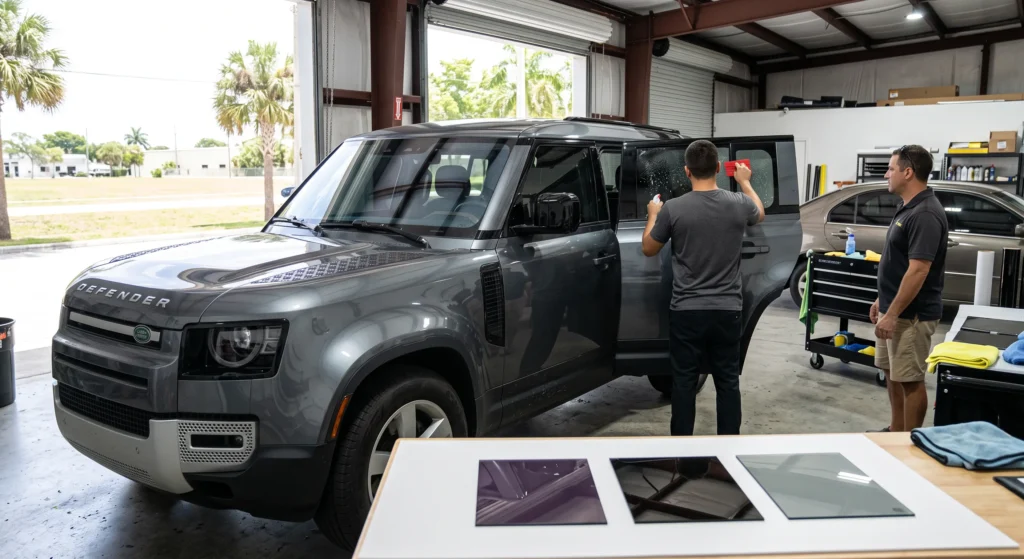
For Window Tinting in Carver Heights, FL, call (305) 788-9933 or use the 305 Auto Customs contact page to request an appointment.
Window Tint FAQs
1. What are the main window tint film grades?
There is no universal automotive tint grade scale. A more useful comparison is film construction. STEK’s automotive lineup includes ACTION+ carbon film, SMART+ nano-ceramic film, and NEX+ graphene-infused ceramic film.
2. Is ceramic window tint better for heat than carbon tint?
STEK states that its SMART+ ceramic film provides more solar heat control than its carbon film. NEX+ is positioned above SMART+ for heat rejection. The right film still depends on your vehicle, driving habits, shade choice, and goals.
3. Does darker tint reject more heat?
Not automatically. VLT measures visible light, while IRER and TSER deal with solar-energy characteristics. A lighter ceramic film can provide strong heat rejection even though it looks much lighter than a dark carbon film.
4. Does carbon window tint block UV rays?
STEK lists 99% UV rejection for its ACTION+ carbon film shades. Its SMART+ and NEX+ lines also list 99% UV rejection.
5. What tint level is legal on front side windows in Florida?
Florida Statute 316.2953 requires at least 28% visible light transmission on qualifying front side windows after the film is applied and tested on the vehicle glass. Visible-light reflectance cannot exceed 25%.
6. Can SUVs use darker tint on rear windows in Florida?
Certain vehicles that meet Florida’s definition of a multipurpose passenger vehicle may use rear film with at least 6% visible light transmission, subject to the other conditions in Florida Statute 316.2954. Many passenger vehicles have a 15% minimum rear-window requirement.
7. How do I schedule Window Tinting in Carver Heights, FL?
Call 305 Auto Customs at (305) 788-9933 or visit the contact page. Tell the team your vehicle year, make, model, desired coverage, and whether heat, privacy, glare, or appearance is your main goal.
Sources
- Publisher: STEK USA
- Publication Date: Page does not list a clear publication date
- Used for the ACTION+, SMART+, and NEX+ film-series comparison and film construction.
- Publisher: STEK USA
- Publication Date: Page does not list a clear publication date
- Used for ACTION+ carbon construction, VLT choices, UV rejection, IRER, glare reduction, TSER, and warranty information.
- Publisher: STEK USA
- Publication Date: Page does not list a clear publication date
- Used for SMART+ nano-ceramic construction, VLT choices, IRER, UV rejection, glare reduction, TSER, and warranty information.
- Publisher: STEK USA
- Publication Date: Page does not list a clear publication date
- Used for NEX+ graphene-infused ceramic construction, VLT choices, IRER, UV rejection, glare reduction, TSER, and warranty information.
- Publisher: 305 Auto Customs
- Publication Date: Page does not list a clear publication date
- Used for ceramic tint package coverage and 305 Auto Customs window tint service information.
- Publisher: Florida Legislature
- Publication Date: 2026 Florida Statutes
- Used for Florida definitions involving transmittance, reflectance, sunscreening material, and multipurpose passenger vehicles.
- Publisher: Florida Legislature
- Publication Date: 2026 Florida Statutes
- Used for windshield sunscreening rules and the upper windshield strip provision.
- Publisher: Florida Senate
- Publication Date: 2026 Florida Statutes
- Used for the 28% front-side-window visible light transmission requirement and 25% reflectance limit.
- Publisher: Florida Senate
- Publication Date: 2026 Florida Statutes
- Used for rear-window visible light transmission, reflectance, and multipurpose passenger vehicle rules.
- Florida Statute 316.2955: Compliance Labeling and Tolerances
- Publisher: Florida Legislature
- Publication Date: 2026 Florida Statutes
- Used for compliance-label and measurement-tolerance information.
- Carver Heights Neighborhood Profile
- Publisher: NeighborhoodScout
- Publication Date: Page does not list a clear publication date
- Used only to confirm Carver Heights as a neighborhood in Deerfield Beach, FL.
Is Ceramic Coating Worth It for Your Car in Davie, FL? | 305 Auto Customs
Is ceramic coating worth it for your car in Davie, FL? Learn how ceramic coating helps keep paint cleaner, adds gloss, and makes car care easier in South Florida.
Product Brand: Malbor Coatings
5
Pros
- Is ceramic coating worth it for your car in Davie, FL? Learn how ceramic coating helps keep paint cleaner, adds gloss, and makes car care easier in South Florida.
