

Window tinting in Golden Glades, FL can make daily commuting more comfortable by helping reduce solar heat, harsh glare, and UV exposure inside your vehicle. Whether you’re traveling along I-95, heading toward the Palmetto Expressway, or spending time in traffic near the Golden Glades Interchange, the South Florida sun can make your car feel warmer than you’d like. Choosing the right window film can make a noticeable difference, but not every tint grade offers the same performance.
Some drivers want darker windows for privacy. Others care more about keeping the cabin comfortable during a long afternoon commute. You might want both, along with a film that looks clean and maintains good visibility when you’re traveling after sunset.
That’s where comparing window tint grades becomes useful.
Carbon, ceramic, and advanced ceramic films offer different levels of heat rejection, glare reduction, and optical clarity. The darkness of the film doesn’t tell the entire story, either. A lighter ceramic film may reject more solar heat than a darker product with a different construction.
At 305 Auto Customs, we offer professional automotive window tinting for drivers throughout Golden Glades, FL, Miami, FL, Davie, FL, Broward County, FL, and Miami-Dade County, FL. Our shop installs STEK and Geoshield ceramic window films for car owners who want help managing heat, sunlight, and everyday comfort.
Before choosing a tint, it helps to understand how the different film grades work, what the performance numbers mean, and which shades comply with Florida law.
Let’s break it down.
Table of Contents
- Why Window Tinting Makes Sense in Golden Glades
- What Window Tint Grades Really Mean
- Dyed Window Tint for Appearance and Glare
- Carbon Window Tint for Daily Commuters
- Ceramic Window Tint for Better Heat Control
- Advanced Ceramic Window Tint Options
- Carbon vs Ceramic Tint: Film Grade Comparison
- Understanding VLT, TSER, and Infrared Rejection
- Florida Window Tint Laws for Commuters
- Choosing the Right Tint for Your Daily Commute
- Window Tint for Cars, SUVs, Trucks, and Teslas
- How Professional Window Tint Installation Works
- How Long Does Automotive Window Tint Last?
- How to Care for Your Window Tint
- Window Tinting Near Golden Glades and Miami
- Schedule Window Tint with 305 Auto Customs
- Frequently Asked Questions
- Sources
Why Window Tinting in Golden Glades, FL Makes Sense for Commuters
Golden Glades, FL sits near one of South Florida’s major highway connections.
The Golden Glades Interchange brings together several routes used by commuters traveling between Miami-Dade County, FL and Broward County, FL.
The South Florida Regional Transportation Authority identifies I-95, US 441, and SR 826 as roads providing access to the Golden Glades Station.
For drivers traveling through the area, that often means spending time on open highways, waiting at traffic signals, and sitting in slow-moving traffic under the sun.
Morning and Afternoon Sun Can Affect Cabin Comfort
Imagine leaving home for work on a warm South Florida morning.
Your car has been sitting outside, and the seats already feel warm. You turn on the air conditioning, but sunlight continues entering through the windows.
Later, during the afternoon commute, the sun may shine through a side window and directly onto your arm or face.
Automotive window film can help reduce some of the solar energy entering through treated glass.
The amount of improvement depends on the film’s performance, your vehicle’s glass, and the sunlight conditions.
Why Daily Commuters Choose Automotive Tint
Common reasons for installing window tint include:
- Reducing solar heat entering the cabin
- Cutting bright sunlight through side windows
- Improving daytime glare control
- Limiting UV exposure through treated glass
- Adding privacy for passengers
- Giving the vehicle a cleaner exterior appearance
- Helping reduce sunlight exposure on seats and interior trim
- Making regular commuting more comfortable
Window tint doesn’t eliminate the need for air conditioning or prevent a parked vehicle from becoming hot.
It does offer a way to manage part of the sunlight entering the interior.
Golden Glades Commuters Have Different Needs
Someone who commutes during daylight may care most about heat rejection.
A person working late shifts may prefer a lighter film that maintains more visibility after dark.
A parent with children riding in the rear seats may want additional sunlight control on the back windows.
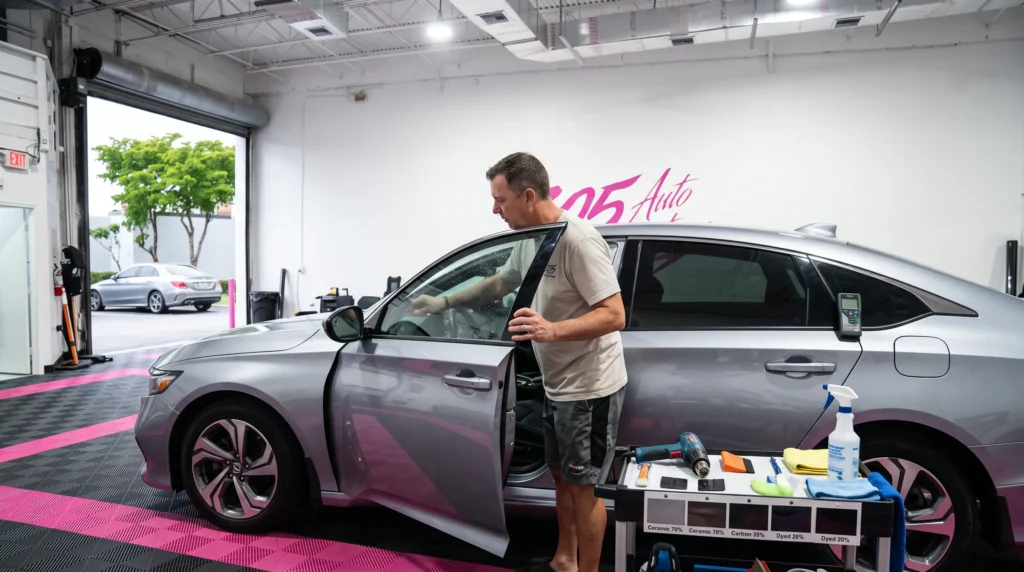
Window tinting in Golden Glades, FL should be selected around how the vehicle is used, not simply the darkest shade available.
What Do Different Window Tint Grades Actually Mean?
When people talk about window tint grades, they are usually comparing the film’s materials, construction, and performance.
You may hear terms such as dyed, carbon, ceramic, nano-ceramic, and graphene-infused ceramic.
These labels describe different film technologies.
They are not a universal ranking system, and two products carrying the same description may perform differently.
Window Tint Grade vs Window Tint Percentage
Here’s an important distinction.
Film grade describes the product’s construction and performance category.
Tint percentage describes how much visible light passes through the material.
A carbon film and a ceramic film can both have similar visible light transmission ratings while offering different levels of solar heat rejection.
That means the film with the darker appearance isn’t necessarily the film that blocks more total solar energy.
What Should You Compare?
Before selecting automotive tint, review:
- Visible Light Transmission (VLT)
- Total Solar Energy Rejection (TSER)
- Infrared Energy Rejection (IRER)
- UV rejection
- Visible-light reflectance
- Optical clarity
- Film warranty
- Compatibility with your vehicle
The STEK automotive window film lineup includes carbon, ceramic, and graphene-infused ceramic products with published performance specifications.
Looking at those numbers can help explain what separates one film grade from another.
Dyed Window Tint: An Entry-Level Option for Appearance and Glare
Dyed window film is one of the familiar types of automotive tint.
It uses dye within the film to absorb some visible light and create a darker appearance.
Many drivers associate dyed film with the traditional look of tinted vehicle windows.
What Does Dyed Window Tint Do?
A dyed film can reduce incoming visible light and provide a darker appearance.
That may help control some daytime glare.
Depending on the product, it may also offer UV protection and a degree of solar heat control.
But the performance varies.
A dark dyed film shouldn’t be assumed to reject the same amount of solar energy as a ceramic film.
Things to Consider Before Choosing Dyed Tint
Film construction matters.
Lower-performing dyed films may have more limited heat rejection than other available technologies.
Color stability and long-term appearance also depend on the product.
If your biggest concern is how hot your cabin feels while commuting, ask about published total solar energy rejection rather than judging a sample only by darkness.
For window tinting in Golden Glades, FL, commuters who want strong heat control may prefer to compare carbon and ceramic options before deciding.
Carbon Window Tint for Golden Glades, FL Daily Commuters
Carbon window tint uses carbon-based materials to provide a darker appearance with solar-control properties.
Unlike some metallized films, nonmetallic carbon construction is designed to avoid the radio-frequency interference concerns associated with certain metal-containing products.
That can matter for drivers using mobile phones, GPS navigation, and other connected devices.
How Carbon Window Tint Works
Carbon film can reduce visible light, UV exposure, and a portion of solar heat.
The amount depends on the film series and shade.
The appearance is often a neutral dark tone rather than a strongly mirrored finish.
STEK ACTION+ Carbon Window Film
STEK ACTION+ carbon window tint is one manufacturer example.
STEK describes ACTION+ as a carbon film designed for color stability, clarity, UV protection, and solar heat rejection.
The manufacturer publishes a Total Solar Energy Rejection rating of up to 55% within the ACTION+ lineup.
That upper figure applies to certain products and test conditions, not every shade or installed vehicle.
STEK also publishes limited lifetime warranty terms for qualifying ACTION+ products.
Is Carbon Film Right for Your Commute?
Carbon tint is worth considering if you want an attractive darker appearance, some heat rejection, and a nonmetallic film.
But if reducing solar heat is your main concern, compare the carbon film’s specifications with ceramic products at similar VLT levels.
305 Auto Customs currently advertises STEK and Geoshield ceramic tint services. Ask the shop whether a particular carbon film is available rather than assuming every manufacturer series is stocked.
Ceramic Window Tint in Golden Glades, FL for Heat and Glare Control
Ceramic tint is a popular choice among commuters because it can provide solar heat rejection without requiring very dark windows.
Automotive ceramic films use fine ceramic materials as part of their construction.
These films can reduce selected wavelengths of solar energy while maintaining different levels of visible light transmission.
Why Ceramic Tint Appeals to Daily Commuters
Picture sitting in traffic on I-95 while sunlight reaches the driver’s side glass.
A suitable ceramic film can reduce some of the solar energy entering through that window.
The exact improvement depends on the film and glass combination.
Many drivers like the balance between heat rejection and visibility.
That can be useful when your commute includes both sunny afternoons and darker evening conditions.
STEK SMART+ Nano-Ceramic Window Film
STEK SMART+ ceramic window tint uses nano-ceramic film technology.
STEK publishes several performance measurements for the SMART+ series, including:
- Total solar energy rejection
- Infrared energy rejection
- Visible light transmission
- UV rejection
- Glare reduction
Its published SMART+ specifications show up to 60% total solar energy rejection for certain shades.
The manufacturer also lists 99% UV rejection and a limited lifetime warranty subject to its terms.
Can Lighter Ceramic Tint Still Reject Heat?
Yes.
One of the advantages of comparing film technology instead of darkness alone is that lighter ceramic products may offer useful heat rejection.
A product with higher VLT allows more visible light through, which some commuters prefer.
The amount of solar heat rejected still depends on the exact film.
This is why window tinting in Golden Glades, FL should involve reviewing performance numbers before choosing a shade.
Advanced Ceramic Window Tint Options for Long Commutes
Some manufacturers offer several ceramic film series with different constructions and solar-control performance.
STEK, for instance, offers a graphene-infused ceramic line called NEX+.
Graphene-infused is a description of the material used in that product, not a guarantee that every film using graphene will outperform every other ceramic film.
STEK NEX+ Graphene-Infused Ceramic Film
According to STEK’s NEX+ product information, the series combines ceramic and graphene-based materials.
The manufacturer publishes Total Solar Energy Rejection ratings reaching 64% for certain shades in the lineup.
STEK also lists:
- Different visible light transmission choices
- Infrared energy rejection measurements
- UV rejection ratings
- Glare reduction data
- Limited lifetime warranty coverage
The published figures vary by shade.
How Does Advanced Ceramic Compare with Regular Ceramic?
The difference becomes clearer when comparing films with similar darkness.
A higher-performing ceramic product may reject more solar energy while allowing about the same amount of visible light into the cabin.
This matters for drivers who want better heat control without choosing darker glass.
Do You Need the Highest Grade?
Not everyone does.
Someone who commutes short distances and parks under cover may have different needs from a driver who spends several hours traveling during sunny afternoons.
The right choice depends on performance, desired appearance, legal tint limits, and available products.
Ask 305 Auto Customs about the ceramic series currently offered and which one fits your vehicle.
Carbon vs Ceramic Window Tint: Comparing Film Grades
Let’s compare actual manufacturer specifications rather than treating every carbon or ceramic film as identical.
The following table uses selected STEK ACTION+, SMART+, and NEX+ films with similar published visible light transmission.
STEK Window Film Performance Comparison
| Manufacturer film | Film type | Published VLT | Published TSER |
|---|---|---|---|
| STEK ACTION 35 | Carbon | 34% | 38% |
| STEK SMART 35 | Nano-ceramic | 34% | 49% |
| STEK NEX 35 | Graphene-infused ceramic | 34% | 56% |
Source: STEK USA’s published ACTION+, SMART+, and NEX+ performance tables.
These are manufacturer-published specifications measured under the manufacturer’s test conditions. Actual results depend on the glass and installed film. The table does not confirm product availability at 305 Auto Customs or whether a particular shade would comply with Florida law on your vehicle.
What Does This Comparison Tell You?
All three listed films have a published VLT of 34%.
That means their visible-light transmission ratings are similar.
Their published solar heat rejection ratings are different.
The NEX 35 rating is higher than the SMART 35 rating, which is higher than the ACTION 35 rating.
This shows why choosing a film based only on darkness can leave out useful information.
For Golden Glades commuters focused on cabin heat, comparing TSER at similar VLT levels is a good starting point.
Understanding VLT, TSER, and Infrared Rejection Before Choosing Tint
Window film data sheets contain several measurements.
You don’t need to become a film technician, but understanding a few terms can make comparing products easier.
What Is VLT?
VLT stands for Visible Light Transmission.
It measures the percentage of visible light passing through the glazing.
A higher VLT means more visible light gets through.
A lower VLT means less light passes through.
A film labeled 70% VLT looks much lighter than one labeled 20% VLT under comparable conditions.
But the final VLT on your vehicle depends on both the film and the existing glass.
What Is TSER?
TSER stands for Total Solar Energy Rejection.
It describes the percentage of total solar energy rejected by the filmed glazing under the specified test method.
A higher TSER indicates greater solar energy rejection under comparable conditions.
This is one of the more useful measurements when selecting tint to help manage cabin heat.
What Is IRER?
IRER means Infrared Energy Rejection.
It measures rejection of infrared energy across a defined wavelength range and accounts for the energy behavior covered by the measurement method.
That is different from a manufacturer’s narrow-band infrared rejection figure measured at one wavelength.
When comparing products, check whether the same measurement method is being used.
What About UV Rejection?
UV rejection describes how much ultraviolet radiation the film blocks under the reported test conditions.
Many modern automotive films offer high UV rejection.
Still, UV rejection and solar heat rejection are different measurements.
A film can block much of the UV radiation without necessarily having the highest overall heat rejection.
Florida Window Tint Laws for Golden Glades, FL Commuters
Choosing the right film also means staying within Florida’s legal requirements.
A shade that looks attractive on a sample display may not meet state limits once installed on a car.
Florida measures the combined effect of the window glass and film.
Florida Front Side Window Tint Limit
Under Florida Statutes, Section 316.2953, front side windows must allow at least 28% visible light transmission after sunscreening material is applied and tested on the vehicle.
The visible-light reflectance cannot exceed 25% under the statutory measurement method.
These limits apply to front side windows adjacent to the driver and front passenger.
Florida Rear Window Tint Limits
Florida Statutes, Section 316.2954 sets separate requirements for covered windows behind the driver.
For ordinary passenger cars, the minimum permitted VLT for covered rear windows is 15%.
For qualifying multipurpose passenger vehicles, the law allows a minimum of 6% VLT on applicable rear windows.
The covered film must also meet a maximum 35% visible-light reflectance requirement.
Vehicle classification matters. An SUV-shaped vehicle should not automatically be assumed to qualify for the multipurpose passenger vehicle provision without checking the applicable definition.
Florida Tint Limits at a Glance
| Window position | Passenger car | Qualifying multipurpose passenger vehicle |
|---|---|---|
| Front side windows | At least 28% VLT | At least 28% VLT |
| Rear side windows | At least 15% VLT | At least 6% VLT |
| Rear window | At least 15% VLT | At least 6% VLT |
| Front side reflectance | No more than 25% | No more than 25% |
| Rear-window reflectance | No more than 35% | No more than 35% |
| Windshield | General rule permits a transparent upper strip within the AS/1 area | Same general rule |
This table summarizes Florida’s general limits for conventional film. Certain exemptions and other sunscreening materials are covered by separate legal provisions.
Why a Film Labeled 35% Might Not Be Legal on Front Windows
Here is the catch.
Factory window glass already reduces some visible light.
Adding film lowers the combined light transmission.
That means a film with a published VLT near 35% may produce a final reading below Florida’s 28% front side window minimum.
The installer should account for the original glazing and measure the finished glass-and-film combination.
Don’t assume a shade is legal simply because of the number printed on the film sample.
What About Windshield Tint?
Under Florida Statutes, Section 316.2952, the general rule permits transparent sunscreening along the upper portion of the windshield within the allowed AS/1 region.
A full windshield ceramic film isn’t automatically legal just because it looks nearly clear.
Any proposed application must comply with applicable law, including any qualifying exemption.
Florida Tint Compliance Labels
Florida also requires compliance labeling for covered aftermarket sunscreening installations.
Under Section 316.2955, the installer must place the required label inside the left door jamb.
The statute also provides a three-percentage-point measurement tolerance.
That tolerance should not be used as a reason to deliberately select a film that falls outside the stated limits.
For window tinting in Golden Glades, FL, legal compliance should be part of the decision before installation begins.
Choosing Window Tint for Your Daily Golden Glades Commute
The right tint depends on when you travel, how much sunlight reaches your windows, and what you want from the film.
Two drivers using the same highway may prefer different products.
For Morning Commuters
Morning sunlight can create glare when it shines through the windshield or side windows.
A suitable, legally compliant side-window film may help reduce brightness.
Keep forward visibility in mind.
A tint that’s comfortable under direct sunlight can feel darker when traveling under heavy cloud cover, through shaded areas, or before sunrise.
For Afternoon Commuters
Afternoon travel often brings strong sunlight and warm cabin conditions.
If reducing solar heat is your concern, compare ceramic films using TSER and related performance measurements.
Don’t assume the darkest film provides the greatest heat rejection.
A lighter ceramic product may offer the balance you’re looking for.
For Evening and Nighttime Commuters
If you often return home after dark, visibility matters.
Darker tint can reduce the amount of light reaching your eyes through the glass.
That may make it harder to see certain objects, pedestrians, or surroundings in low-light conditions.
Think about nighttime use before choosing a darker rear-window shade.
For Drivers Who Leave Their Cars Outdoors
Some Golden Glades commuters park their vehicles outside for long stretches of the day.
Even a good ceramic film can’t stop a parked car from heating up.
Parking in shade, using a suitable sunshade, and allowing hot air to escape when safe can complement window film.
Never leave children or pets in a parked vehicle, even when it has tinted windows.
Window Tint Options for Cars, SUVs, Trucks, and Teslas
Window tinting in Golden Glades, FL isn’t limited to one kind of vehicle.
Sedans, SUVs, pickup trucks, work vehicles, and electric cars all have different glass shapes and tint requirements.
Sedans and Daily Commuter Cars
Sedans often have separate front side windows, rear side windows, and rear glass.
A driver may want the front windows tinted to a compliant shade while choosing a different legal shade for the rear.
The decision should account for visibility, heat rejection, and the car’s existing glass.
SUVs and Family Vehicles
Larger vehicles may have more glass area and existing factory privacy glazing.
Factory privacy glass can look dark without offering the same heat rejection as a selected ceramic film.
The installer should check the existing glass and vehicle classification before choosing additional film.
Pickup Trucks and Work Vehicles
Pickup owners may want ceramic tint for comfort while traveling between job sites.
Large rear windows and side glass can allow noticeable sunlight into the cabin.
For drivers who keep equipment in their trucks, privacy may also be a concern.
Remember that tint offers visual privacy under certain lighting conditions, not protection against theft.
Tesla and Other Electric Vehicles
Electric vehicles can benefit from suitable ceramic window film.
Some have large glass roofs or curved rear windows that require careful product selection.
305 Auto Customs also offers Tesla window tint services for Model 3, Model Y, Model S, and Model X owners.
Glass roof tint requires a separate compatibility review. Not every automotive film is suitable for every panoramic roof.
The goal is to choose a film that works with the vehicle rather than apply the same product to every piece of glass.
How Professional Window Tint Installation Works
A good tint installation begins before the film reaches the window.
Glass condition, old film, existing tint, and the shape of each window can affect the finished result.
Step 1: Discuss Your Tint Goals
Start by explaining what you want.
Are you concerned about heat, glare, privacy, or the vehicle’s appearance?
Tell the shop which windows you want treated.
305 Auto Customs advertises options for front side windows and broader side-and-rear glass coverage.
Any windshield request must be reviewed for legal compliance.
Step 2: Review the Film Options
The installer can discuss available ceramic products and their performance specifications.
Compare the published VLT, TSER, and warranty information.
If you’re unsure about the shade, ask to review samples.
Step 3: Check the Existing Glass
The technician inspects the glass and any existing film.
Older tint may need removal.
Factory glazing and vehicle classification must be considered when selecting a legal shade.
Step 4: Prepare the Windows
The glass is cleaned to remove dirt, grease, and residue.
A clean installation surface helps reduce contamination trapped between the film and glass.
Step 5: Install the Film
The technician fits the film to the approved windows.
Curved glass may require shaping before installation.
The film is positioned and finished according to the manufacturer’s instructions.
Step 6: Review the Finished Tint
Before leaving, ask about:
- When the windows can be lowered
- When cleaning can begin
- Expected curing conditions
- Warranty terms
- What to do if moisture remains
- How to care for the film
The installation and curing requirements depend on the product, glass, and weather conditions.
How Long Does Automotive Window Tint Last in South Florida?
Window tint durability depends on the material, installation, vehicle use, and care.
A vehicle parked in a covered garage may experience different conditions from one that sits outside every day.
Film warranties also vary.
What Affects Tint Durability?
Several factors can affect how film ages:
- Film construction
- Brand and product series
- Glass preparation
- Installation methods
- Sun exposure
- Window movement
- Cleaning products
- Existing glass condition
STEK publishes limited lifetime warranty coverage for qualifying ACTION+, SMART+, and NEX+ products.
The exact terms and covered defects should be checked for the film being installed.
Signs Your Existing Tint May Need Replacement
Look for:
- Peeling corners
- Persistent bubbling
- Purple or uneven discoloration
- Adhesive failure
- Scratches that affect visibility
- Cloudiness that remains after the curing period
If your older tint has these problems, professional removal and replacement may be appropriate.
Window tinting in Golden Glades, FL can also be considered when buying a used car with faded film or when changing vehicles.
How to Care for Your Window Tint After Installation
Fresh window tint needs time to dry and settle.
The exact curing period depends on the film, weather, and glass configuration.
Wait Before Lowering the Windows
Don’t repeatedly lower freshly tinted windows before the installer says it’s safe.
The film needs time to settle and bond properly.
Some vehicles automatically move their side glass when doors open.
Tell the technician if your car has frameless windows or another unusual window mechanism.
Use Film-Safe Cleaners
Once cleaning is permitted, use a soft cloth and an approved cleaner.
Avoid abrasive pads, scraping tools, and harsh chemicals.
The International Window Film Association recommends nonabrasive cleaning methods for treated glass.
Don’t Pick at Small Moisture Pockets
Fresh film may show some temporary moisture or haziness while drying.
Do not puncture a moisture pocket or try to peel the film away.
Ask your installer how long curing should take for your product.
If an issue remains beyond the expected period, contact the shop.
Avoid Sharp Objects Against the Film
Hard scraping tools can scratch window film.
Be careful when cleaning the interior side of tinted glass.
Regular gentle care can help preserve the appearance of the film throughout everyday use.
Window Tinting Near Golden Glades, FL and Surrounding South Florida Communities
305 Auto Customs offers automotive ceramic window tint from our shop in Miami, FL.
We welcome drivers from Golden Glades, FL and nearby communities throughout Miami-Dade County, FL and Broward County, FL.
Serving Golden Glades, FL and North Miami Areas
Drivers from Golden Glades, FL, Miami Gardens, FL, North Miami Beach, FL, North Miami, FL, Opa-locka, FL, and nearby neighborhoods can contact our team about window tint.
Our shop is located in Miami, FL rather than Golden Glades, FL.
Whether you commute toward downtown Miami or travel north for work, suitable tint can help manage sunlight entering your vehicle.
Serving Miami, FL and Miami-Dade County, FL
We also welcome customers from:
- Miami, FL
- Aventura, FL
- Hialeah, FL
- Miami Lakes, FL
- Miami Springs, FL
- Doral, FL
- Miami Shores, FL
- Other communities in Miami-Dade County, FL
Our team provides ceramic window tint for a range of personal and work vehicles.
Serving Davie, FL and Broward County, FL
Drivers from Davie, FL, Hollywood, FL, Fort Lauderdale, FL, Miramar, FL, Pembroke Pines, FL, and other Broward County, FL communities can also contact 305 Auto Customs.
Daily commuters traveling between both counties may want to discuss heat rejection, visibility, and legal window tint choices before scheduling.
Related Automotive Services
305 Auto Customs offers several exterior styling and protection services.
Along with ceramic window tint, customers can ask about:
These services serve different purposes.
Window tint addresses glass, glare, solar heat, and privacy.
Paint protection film helps guard suitable painted surfaces against certain road hazards.
Ceramic coating focuses on exterior surface care and finish appearance.
If you’re interested in more than one service, discuss the projects when booking.
Why Choose 305 Auto Customs?
305 Auto Customs works with automotive film and vehicle styling for customers across South Florida.
Our shop offers STEK and Geoshield ceramic window tint, along with STEK paint protection products and Malbor Coatings ceramic coating services.
We’re STEK certified and a STEK vendor for applicable automotive protection products.
We also carry warranties on our products and services.
Ask about the exact window film series, available shades, and applicable warranty when discussing your tint appointment.
Schedule Window Tinting in Golden Glades, FL with 305 Auto Customs
Window tinting in Golden Glades, FL can make everyday commuting more comfortable when you select a film suited to your vehicle and the way you travel.
Carbon film offers one type of solar-control performance.
Ceramic film may provide stronger heat rejection at a similar visible light transmission level.
Advanced ceramic products offer another range of manufacturer specifications worth comparing.
But the right choice isn’t always the darkest film or the highest grade.
Think about your commute, daytime heat, nighttime visibility, and Florida’s legal requirements.
At 305 Auto Customs, we help customers compare available ceramic window tint options for daily-use vehicles.
Whether you own a sedan, SUV, pickup truck, luxury vehicle, or Tesla, our team can discuss your goals and help you choose a suitable installation.
Contact 305 Auto Customs
Business Name: 305 Auto Customs
Shop Address: 19597 NE 10th Ave, Bay F, Building 6, Miami, FL 33179
Phone: (305) 788-9933
Business Hours:
- Monday through Friday: 8 AM to 6 PM
- Saturday: 10 AM to 5 PM
- Sunday: 10 AM to 5 PM
Website: 305autocustomsfl.com
Schedule an Appointment: Contact 305 Auto Customs
Before contacting us, have your vehicle’s year, make, and model ready.
Tell us whether you’re interested in front side windows, rear glass, or a more extensive legal tint setup.
You can also ask about STEK and Geoshield ceramic films, available performance grades, and warranty coverage.
Call (305) 788-9933 or visit our contact page to schedule your window tint appointment.
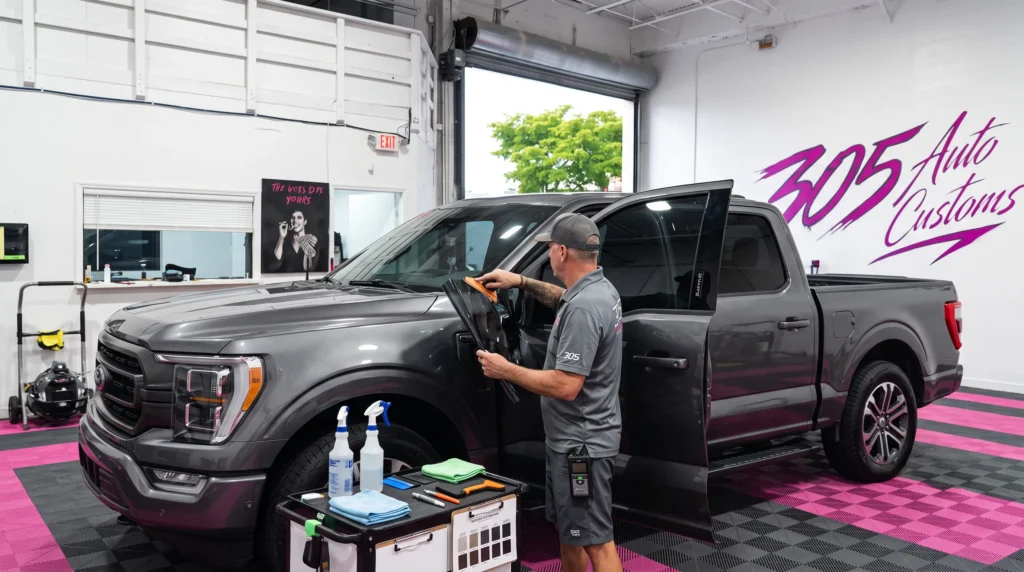
We welcome commuters from Golden Glades, FL, Miami, FL, Davie, FL, Broward County, FL, Miami-Dade County, FL, and surrounding South Florida communities.
Frequently Asked Questions About Window Tinting in Golden Glades, FL
1. What Window Tint Grade Is Good for Daily Commuters in Golden Glades, FL?
Ceramic window tint is worth considering for commuters who want heat rejection, glare control, and comfortable visibility. Carbon film is another option, but performance varies by product. Compare published TSER and VLT ratings rather than choosing based on darkness alone. 305 Auto Customs installs STEK and Geoshield ceramic tint and can discuss available film grades for your vehicle.
2. Is Ceramic Window Tint Better Than Carbon Tint for South Florida Heat?
Ceramic films can offer higher total solar energy rejection than comparable carbon products. STEK’s published film specifications show differences between its ACTION+ carbon, SMART+ ceramic, and NEX+ graphene-infused ceramic series. The exact result depends on the film shade, glass, and test conditions. A lighter ceramic film may also offer useful heat rejection without an extremely dark appearance.
3. What Is the Legal Window Tint Percentage in Florida?
Florida requires at least 28% VLT for front side windows. Covered rear windows must generally allow at least 15% VLT for passenger cars, while qualifying multipurpose passenger vehicles may use film resulting in at least 6% VLT for applicable rear windows. Reflectance limits also apply. The installed glass-and-film combination must comply with the law.
4. Can I Get Window Tint That Blocks Heat Without Making My Windows Very Dark?
Yes. Certain ceramic films offer solar heat rejection while allowing relatively high levels of visible light through the glass. Look at Total Solar Energy Rejection and visible light transmission together. A product’s actual heat performance matters more than simply choosing a dark-looking shade. Ask 305 Auto Customs about lighter ceramic tint options that meet Florida requirements.
5. Does Window Tint Help with Glare During Morning and Afternoon Commuting?
Window film can reduce some incoming visible light and make harsh sunlight less distracting. The degree of glare reduction depends on the film and shade. Darker windows can also reduce visibility at night, so choosing the right balance matters. A driver who regularly commutes after sunset may prefer a lighter film than someone who travels mostly during daylight.
6. How Long Does Ceramic Window Tint Last in Miami-Dade County, FL?
Ceramic tint lifespan depends on the film series, installation, sun exposure, window use, and cleaning. STEK publishes limited lifetime warranties for qualifying products, subject to the applicable terms. Signs of film problems include persistent bubbling, peeling, and discoloration. Ask 305 Auto Customs about warranty coverage and care instructions for your selected film.
7. Where Can I Schedule Window Tinting Near Golden Glades, FL?
Contact 305 Auto Customs at (305) 788-9933 or visit 305autocustomsfl.com/contact-us. Our shop is located at 19597 NE 10th Ave, Bay F, Building 6, Miami, FL 33179. We serve drivers from Golden Glades, FL, Miami, FL, Davie, FL, Broward County, FL, Miami-Dade County, FL, and nearby communities with professional ceramic window tint services.
Sources
The following resources support the information about window film grades, manufacturer performance specifications, Florida tint laws, Golden Glades transportation routes, and services offered by 305 Auto Customs.
1. STEK Automotive Window Tint
- Publisher: STEK USA
- Publication Date: Not listed
- URL: STEK Automotive Window Film
- Reference: ACTION+, SMART+, and NEX+ film series, product construction, shade choices, and published performance features.
2. ACTION+ Carbon Window Tint
- Publisher: STEK USA
- Publication Date: Not listed
- URL: STEK ACTION+ Carbon Tint
- Reference: Carbon film construction, VLT, TSER, infrared energy rejection, UV rejection, and limited lifetime warranty terms.
3. SMART+ Nano-Ceramic Window Tint
- Publisher: STEK USA
- Publication Date: Not listed
- URL: STEK SMART+ Ceramic Tint
- Reference: Ceramic film specifications, solar heat rejection, visibility, glare reduction, and UV protection.
4. NEX+ Graphene-Infused Ceramic Window Tint
- Publisher: STEK USA
- Publication Date: Not listed
- URL: STEK NEX+ Ceramic Tint
- Reference: Graphene-infused ceramic construction, VLT, TSER, infrared rejection, UV rejection, and warranty information.
5. Florida Statutes, Section 316.2953: Side Windows
- Publisher: Florida Legislature
- Publication Date: 2026 statutory edition
- URL: Florida Front Side Window Tint Law
- Reference: Minimum front side window VLT of 28% and maximum visible-light reflectance of 25%.
6. Florida Statutes, Section 316.2954: Windows Behind the Driver
- Publisher: Florida Legislature
- Publication Date: 2026 statutory edition
- URL: Florida Rear Window Tint Law
- Reference: Rear-window VLT requirements for passenger cars and qualifying multipurpose passenger vehicles, plus reflectance limits.
7. Florida Statutes, Section 316.2952: Windshields
- Publisher: Florida Legislature
- Publication Date: 2026 statutory edition
- URL: Florida Windshield Restrictions
- Reference: Windshield sunscreening restrictions and the permitted transparent upper strip.
8. Florida Statutes, Section 316.2955: Compliance Labeling and Tolerances
- Publisher: Florida Legislature
- Publication Date: 2026 statutory edition
- URL: Florida Tint Compliance Requirements
- Reference: Required aftermarket tint labels, installer identification, and statutory measurement tolerance.
9. Frequently Asked Questions About Window Film
- Publisher: International Window Film Association
- Publication Date: Not listed
- URL: IWFA Window Film FAQ
- Reference: Automotive film performance, UV rejection, glare reduction, and film care.
10. Golden Glades Station
- Publisher: South Florida Regional Transportation Authority, Tri-Rail
- Publication Date: Not listed
- URL: Golden Glades Station Information
- Reference: Golden Glades transportation connections, I-95, US 441, SR 826, and commuter parking access.
11. Window Tint Services
- Publisher: 305 Auto Customs
- Publication Date: Not listed
- URL: 305 Auto Customs Window Tint
- Reference: STEK and Geoshield ceramic tint, automotive glass coverage options, warranties, and local service information.
12. Tesla Window Tint Services
- Publisher: 305 Auto Customs
- Publication Date: Not listed
- URL: 305 Auto Customs Tesla Window Tint
- Reference: Ceramic window tint services for Tesla Model 3, Model Y, Model S, and Model X vehicles.
13. Contact 305 Auto Customs
- Publisher: 305 Auto Customs
- Publication Date: Not listed
- URL: Contact 305 Auto Customs
- Reference: Business contact information, shop address, and appointment scheduling.
