
Window tinting in Rock Island, Fort Lauderdale, FL gives car owners a way to manage South Florida’s heat, harsh sunlight, and glare while choosing a look that suits their vehicle. But one of the first questions people ask is, “How dark should I go?” You might like the appearance of dark rear windows, prefer a lighter shade for nighttime travel, or want ceramic tint that rejects heat without making your car feel closed in.
The right shade depends on more than personal taste.
Florida has different tint limits for front and rear windows. Your factory glass already reduces some visible light, which changes the final reading after film is installed. And two films with the same darkness can have very different heat rejection ratings.
Picture your usual afternoon trip. You leave your car in an uncovered parking space, return to a warm cabin, and head out while the sun shines through the side glass. A suitable ceramic window film may help reduce the solar heat reaching you without requiring an extremely dark appearance.
At 305 Auto Customs, we provide professional automotive window tinting for vehicle owners from Rock Island, Fort Lauderdale, FL, Davie, FL, Miami, FL, Broward County, FL, and Miami-Dade County, FL.
Our Miami, FL shop installs STEK and Geoshield ceramic window films for daily commuters, SUVs, pickup trucks, luxury cars, and Teslas.
If you’re trying to choose the right tint percentage, this guide explains what the numbers mean, how ceramic film performs, and what Florida law allows.
Table of Contents
- Why Window Tinting Matters in Rock Island
- What Window Tint Shade Percentages Mean
- How to Choose Between Light, Medium, and Dark Tint
- Why Darker Tint Doesn’t Always Reject More Heat
- Ceramic Window Tint Options for South Florida
- Comparing STEK Ceramic Tint Shades
- Florida Window Tint Laws and Legal Percentages
- Why Factory Glass Changes the Final Shade
- Choosing Tint for Morning and Evening Travel
- Privacy, Glare, and Nighttime Visibility
- Window Tint for Cars, SUVs, Trucks, and Teslas
- How Professional Window Tint Installation Works
- Window Tint Curing and Aftercare
- Local Window Tint Services Near Rock Island
- Schedule Window Tint with 305 Auto Customs
- Frequently Asked Questions
- Sources
Why Window Tinting in Rock Island, Fort Lauderdale, FL Is Worth Considering
Rock Island is a neighborhood in Fort Lauderdale, FL, located within Broward County, FL.
The City of Fort Lauderdale’s neighborhood association directory lists Rock Island Community Development among the city’s recognized neighborhood organizations.
Local streets connect residents with nearby workplaces, schools, shopping areas, and larger roads used to travel throughout Fort Lauderdale.
During those trips, strong sunlight can make the interior of a vehicle uncomfortable.
What Happens Inside a Car Parked in the Sun?
When sunlight passes through the glass, interior surfaces absorb energy and become warmer.
Seats, dashboards, and other materials can hold that heat.
Even after you turn on the air conditioning, direct sunlight may continue reaching your face, arms, or passengers.
Automotive window film can reduce some of the solar energy entering through the treated glass.
The exact result depends on the film’s construction, its shade, the vehicle’s original glass, and the conditions outside.
Common Reasons Local Vehicle Owners Choose Tint
Drivers researching window tinting in Rock Island often want:
- Less solar heat entering the cabin
- Reduced glare during sunny afternoons
- A more comfortable ride for passengers
- Lower UV exposure through treated windows
- A darker appearance on selected glass
- Additional daytime privacy
- Help limiting UV-related interior fading
- Replacement for peeling or discolored old tint
Not every customer wants the same result.
Someone who commutes after sunset may prefer a lighter film. Another owner may want darker rear passenger glass while keeping the front windows easier to see through.
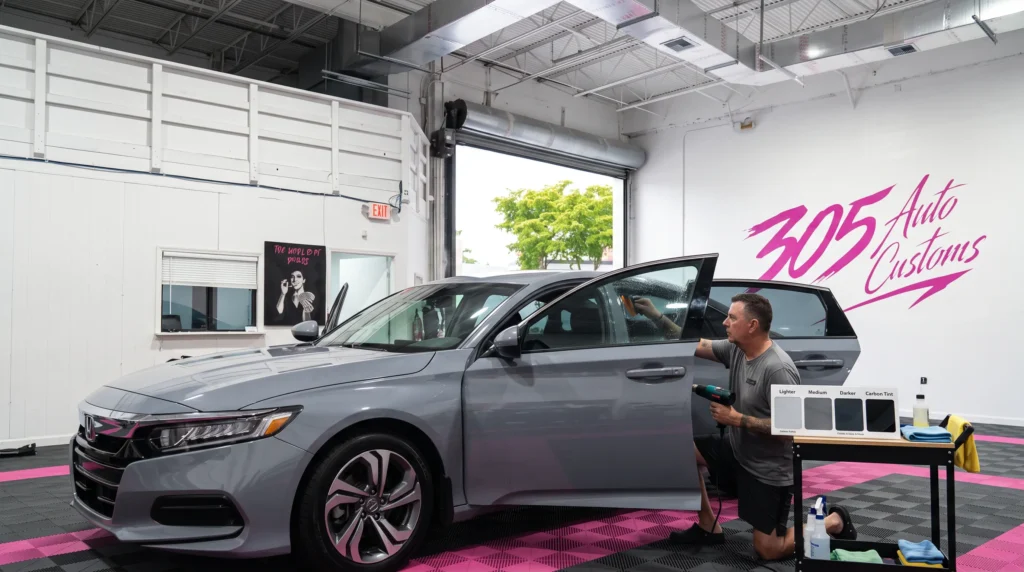
That’s why shade selection should start with how you use your vehicle.
What Do Window Tint Shade Percentages Actually Mean?
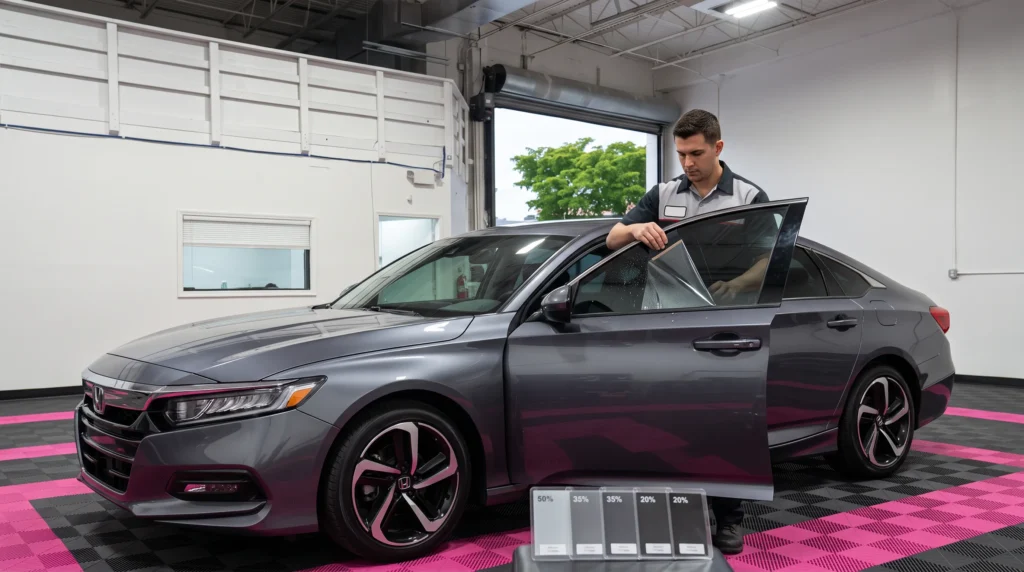
When you look at automotive tint samples, you’ll often see numbers such as 70%, 50%, 35%, 20%, and 5%.
Those percentages describe Visible Light Transmission, usually shortened to VLT.
VLT tells you how much visible light passes through the tested glazing.
Higher VLT Means Lighter Glass
A film with a high VLT allows more visible light through.
A film with a low VLT reduces the amount of visible light entering the vehicle.
Here’s a simple comparison.
| Film shade label | General appearance | What to think about |
|---|---|---|
| 70% VLT | Very light | Keeps much of the visible daylight |
| 50% VLT | Light | Mildly darkens the glass |
| 35% VLT | Medium | Noticeable tint while allowing more light than darker shades |
| 20% VLT | Dark | Greater reduction in visible light |
| 5% VLT | Very dark | Strong reduction in visible light, including at night |
These figures describe general film appearances. They are not recommendations for legal installation on any particular window.
The combined vehicle glass and film must meet Florida’s applicable requirements.
Why a 35% Film Isn’t the Same as a 35% Finished Window
Your car’s glass already transmits less than 100% of visible light.
When you add film, the finished reading changes.
That means a 35% film does not necessarily produce a 35% VLT measurement after installation.
We’ll explain that calculation below because it makes a big difference when choosing a legal shade.
Light, Medium, or Dark Window Tint: Which Should You Choose?
There isn’t one shade that works for every vehicle owner.
The answer depends on your daily travel schedule, privacy preferences, and the type of film you’re considering.
Light Tint for Drivers Who Want More Visibility
Light film can be appealing if you want solar-control benefits without changing the glass appearance too much.
Some ceramic films allow a relatively high amount of visible light while rejecting a portion of incoming solar energy.
This can be useful for motorists who regularly travel early in the morning or after dark.
You may also prefer lighter glass if you frequently enter parking garages or use roads with limited nighttime lighting.
Medium Tint for a Balanced Appearance
A medium-looking shade can provide a darker appearance without going as far as the lowest VLT options.
Many owners like this look because it works with a wide range of vehicle colors.
The final shade should still be checked against the applicable Florida limits.
For window tinting in Rock Island, Fort Lauderdale, FL, medium shades are worth comparing with lighter ceramic films if you want both appearance and heat rejection.
Dark Tint for Rear Passenger Privacy
Some car owners prefer darker rear windows.
A darker shade may make the passenger area less visible from outside under certain lighting conditions.
But dark glass reduces the light entering the cabin at night, too.
Florida also applies different rear-window rules depending on the vehicle’s legal classification.
Don’t choose a shade before confirming which limits apply to your specific vehicle.
Why Darker Window Tint Doesn’t Always Reject More Heat
Here’s what surprises some car owners.
Two films can look equally dark but reject different amounts of solar energy.
That’s because VLT measures visible light transmission, not the complete effect of sunlight on the cabin.
What Does Total Solar Energy Rejection Mean?
Total Solar Energy Rejection, or TSER, describes the percentage of incoming solar energy rejected by a tested glazing system.
The higher the rating under comparable conditions, the greater the solar energy rejection.
TSER is useful when your main concern is a hot interior.
What Is Infrared Energy Rejection?
Infrared Energy Rejection, or IRER, measures how much infrared energy a film rejects across a specified wavelength range.
This is different from a narrow-band infrared figure measured at only one wavelength.
When comparing films, look at TSER and IRER together.
A very high infrared percentage by itself doesn’t tell you the film’s complete solar performance.
Can a Light Ceramic Film Reject More Heat Than Darker Film?
Yes, depending on the products.
A lighter film built with advanced solar-control materials can outperform a darker film with weaker heat rejection.
That’s one reason ceramic tint is worth comparing before choosing a shade.
The International Window Film Association explains that automotive window films can help reduce solar heat, glare, and UV exposure.
The outcome depends on the selected product and installation.
Ceramic Window Tint Options for Rock Island Vehicle Owners
Ceramic window film uses fine ceramic materials as part of its construction.
These films are available in several shades and can provide solar heat rejection without requiring extremely dark glass.
At 305 Auto Customs, we install STEK and Geoshield ceramic window tint.
Why Choose Ceramic Film?
Vehicle owners commonly consider ceramic tint because they want:
- Solar heat rejection
- Glare control
- High UV rejection
- Different legal shade options
- A clean exterior appearance
- Optical clarity
- Product warranty coverage
Not every ceramic film has identical specifications.
Film series, shade, and test conditions matter.
STEK SMART+ Ceramic Tint
STEK SMART+ is a nano-ceramic window film series.
STEK publishes measurements for VLT, TSER, IRER, UV rejection, and glare reduction.
The manufacturer also lists limited lifetime warranty coverage for qualifying products, subject to its terms.
STEK NEX+ Ceramic Tint
STEK NEX+ uses graphene-infused ceramic film construction.
Its published performance ratings differ from SMART+.
Both product lines offer several shades, but availability at 305 Auto Customs should be confirmed when scheduling.
What About Geoshield?
305 Auto Customs also advertises Geoshield ceramic tint.
Ask our team about the exact Geoshield series available for your vehicle.
The most useful comparison is between specific films at similar VLT levels, rather than making a decision based only on the brand name.
Comparing STEK Ceramic Window Tint Shades
Let’s look at published manufacturer data.
STEK offers ceramic films with different levels of visible light transmission and solar heat rejection.
This comparison shows how shade and material selection can affect the result.
STEK Ceramic Window Film Comparison
| STEK product | Published VLT | Published TSER | Published UV rejection |
|---|---|---|---|
| SMART 70 | 69% | 44% | 99% |
| SMART 45 | 43% | 46% | 99% |
| SMART 35 | 34% | 49% | 99% |
| NEX 70 | 66% | 46% | 99% |
| NEX 45 | 45% | 52% | 99% |
| NEX 35 | 34% | 56% | 99% |
Sources: STEK SMART+ technical specifications and STEK NEX+ technical specifications.
These are manufacturer-published ratings under specified test conditions, not measurements from a customer’s installed vehicle. The table does not mean every listed shade is legal on every window or currently available at 305 Auto Customs.
What Can You Learn from These Numbers?
The NEX 35 and SMART 35 films have the same published VLT of 34%.
But NEX 35 has a published TSER of 56%, compared with 49% for SMART 35.
Both films look similarly dark based on their VLT ratings, yet their solar energy rejection differs.
Now compare the lighter options.
NEX 70 allows 66% visible light transmission and has a published 46% TSER.
That shows why a relatively light ceramic film can still offer meaningful solar-control performance.
When considering window tinting in Rock Island, reviewing these specifications can help you choose a film that suits your needs without selecting darkness blindly.
Florida Window Tint Laws: What Shades Are Legal in Fort Lauderdale?
Florida has statewide rules governing aftermarket window tint.
These rules apply in Rock Island, Fort Lauderdale, FL, throughout Broward County, FL, and across Miami-Dade County, FL.
The law measures visible light transmission and reflectance on the vehicle’s glass after the film has been applied.
Florida Front Side Window Tint Limit
Under Florida Statutes, Section 316.2953, front side windows must allow at least 28% visible light transmission.
The same provision limits visible-light reflectance to 25%, measured from the nonfilm side.
This applies to the finished glass-and-film combination.
A film labeled 28% should not be treated as automatically legal on the front windows.
Florida Rear Window Tint Limit
Under Florida Statutes, Section 316.2954, conventional aftermarket film on covered rear windows of ordinary passenger cars must generally allow at least 15% VLT.
For qualifying multipurpose passenger vehicles, the applicable provision permits at least 6% VLT on covered rear windows.
The rear film provision also limits visible-light reflectance to 35%.
Florida Legal Tint Chart
| Window position | Ordinary passenger car | Qualifying multipurpose passenger vehicle |
|---|---|---|
| Front side windows | Minimum 28% VLT | Minimum 28% VLT |
| Rear side windows | Minimum 15% VLT | Minimum 6% VLT |
| Rear window | Minimum 15% VLT | Minimum 6% VLT |
| Front side reflectance | Maximum 25% | Maximum 25% |
| Rear film reflectance | Maximum 35% | Maximum 35% |
| Windshield | Generally limited to a transparent upper AS/1 strip | Same general restriction |
This chart summarizes the general statutory limits for conventional film. Separate provisions apply to certain other materials and qualifying exemptions.
Does Every SUV Qualify for the 6% Rear Rule?
No.
Florida defines a multipurpose passenger vehicle under Section 316.2951.
The classification depends on vehicle construction and qualifying design features.
Do not assume every crossover or SUV automatically qualifies because of its appearance.
Confirm the applicable vehicle category before selecting a darker rear-window shade.
What About Windshield Tint?
Florida Statutes, Section 316.2952 generally restricts aftermarket sunscreening on windshields.
A transparent strip along the upper windshield may be permitted within the allowed AS/1 region.
A nearly clear ceramic film is not automatically legal across the entire windshield.
Medical and other statutory exceptions may apply in qualifying circumstances.
Florida Also Requires a Compliance Label
Florida Statutes, Section 316.2955 requires applicable aftermarket tint installations to have a compliance label inside the left door jamb.
The label identifies the film and installer or seller.
The law also provides a three-percentage-point measurement tolerance.
That tolerance should not be used as permission to knowingly install film outside the stated limits.
Why Factory Glass Changes the Final Window Tint Shade
Here is where choosing a tint can become confusing.
Your car’s factory glass already allows less than 100% of visible light through.
Applying film reduces that transmission further.
A Simple Example of Combined VLT
Suppose your factory front side glass transmits 80% of visible light.
You choose film with a published VLT of 34%.
A simplified calculation is:
80% × 34% = 27.2% combined VLT
That estimated result falls below Florida’s stated 28% front side window minimum.
The example is only an illustration. Actual readings depend on the installed glass, the film, and the measuring equipment.
Why You Shouldn’t Choose by Film Label Alone
A shade marked 35% may produce a different final measurement on two different cars.
The original glass matters.
If you want window tinting in Rock Island that meets Florida law, ask the installer to consider the factory glazing before choosing the film.
What If Your Vehicle Has Factory Privacy Glass?
Some SUVs and pickup trucks come with dark-looking rear glass.
That factory tint may have different solar heat rejection properties from an added ceramic film.
If you’re considering film over existing privacy glazing, the final VLT and film compatibility should be reviewed.
The goal is to select a suitable product without making the rear glass darker than allowed for the vehicle.
Choosing Window Tint for Morning, Afternoon, and Nighttime Travel
The best shade depends partly on when you use your vehicle.
A motorist who travels mostly during daylight may prefer a different setup from someone who frequently returns home late at night.
Morning Trips Around Fort Lauderdale, FL
Early sunlight can reach side windows at low angles.
You may notice bright light while traveling through neighborhood streets or toward work.
A suitable ceramic film can help soften incoming brightness.
If your commute begins before sunrise, remember that tint reduces visible light in darker conditions, too.
Afternoon Travel and Solar Heat
Afternoon sunlight can make side windows uncomfortable.
If you regularly travel throughout Fort Lauderdale, FL and nearby Broward County, FL communities, solar heat rejection may be one of your main priorities.
Compare TSER ratings at similar VLT levels.
You may find that a lighter ceramic film suits your needs better than a darker product with lower solar performance.
Nighttime Visibility Matters
Dark film limits the visible light entering through the glass.
That includes light from streetlamps, pedestrians, parked vehicles, and other surroundings.
Lower VLT can make low-light visibility more difficult.
Before selecting a very dark rear shade, think about parking, reversing, and viewing the surroundings after sunset.
Rainy Weather Is Another Consideration
South Florida rain can reduce visibility even without tinted glass.
Dark windows may make it harder to see surrounding objects in low-light rain conditions.
The right shade should account for your actual travel habits, not just how the car looks under bright showroom lighting.
Picking Window Tint for Privacy and Glare Without Going Too Dark
Privacy and glare control can influence shade selection, but they aren’t the same thing as heat rejection.
Does Dark Tint Give You More Privacy?
Darker glass can make the vehicle interior harder to see from outside in certain lighting conditions.
That can appeal to families, commuters, and owners who prefer a less exposed cabin.
But tint doesn’t provide complete privacy.
At night, interior lighting may make occupants and objects more visible from outside.
Tint also doesn’t protect belongings from theft.
How Much Glare Reduction Do You Need?
If harsh afternoon sunlight is your main concern, think about the direction the sun reaches your windows.
A lighter ceramic film may soften brightness while maintaining more visible light.
A darker film can reduce more glare, but it may also make nighttime viewing less comfortable.
What About UV Protection?
Many modern automotive window films offer high UV rejection.
STEK reports 99% UV rejection for the SMART+ and NEX+ shades discussed above.
UV protection can help reduce one contributor to fading of vehicle upholstery and trim.
It does not stop all fading, and UV rejection should not be confused with complete heat rejection.
Window Tint Shade Choices for Cars, SUVs, Pickup Trucks, and Teslas
Your vehicle’s shape and glass configuration affect the tint plan.
A sedan, SUV, pickup truck, and Tesla may require different installation approaches.
Window Tint for Sedans
Sedans usually have front side windows, rear passenger glass, and a rear windshield.
You may prefer lighter front side tint and a darker legal rear shade.
The installer should confirm how the finished appearance will look across all windows.
SUV Window Tint
Some SUVs have factory privacy glass in the rear passenger area.
That glass may already look dark, but you might still want additional solar heat control.
The installer needs to review the original glazing and confirm the legal vehicle classification.
Pickup Truck Window Tint
Pickup trucks may have sliding rear glass or large crew-cab windows.
A work pickup parked outdoors can receive plenty of sunlight through its side windows.
Ceramic film may help reduce some of that incoming energy.
Tesla Window Tint
Tesla vehicles may have frameless side glass, large curved rear windows, and panoramic roofs.
305 Auto Customs provides Tesla ceramic window tint services for Model 3, Model Y, Model S, and Model X vehicles.
Glass roofs require a separate film-to-glass compatibility review.
A film approved for side windows isn’t automatically suitable for every panoramic roof.
How Professional Window Tint Installation Works
Choosing the right shade is only one part of a window tint project.
The film must also be fitted and installed correctly.
At 305 Auto Customs, customers can discuss coverage options such as two front windows or broader side-and-rear glass tinting.
Step 1: Review Your Vehicle and Goals
Start with your vehicle’s year, make, and model.
Tell the shop whether your biggest concern is heat, glare, privacy, or nighttime visibility.
Also mention any existing aftermarket tint.
Step 2: Compare Available Films
Ask which STEK and Geoshield ceramic films are currently available.
Review the VLT and TSER specifications for each option.
If you’re unsure about shade, ask to see samples before making a decision.
Step 3: Check Factory Glass and Legal Limits
The installer should account for the existing glass and the final light transmission.
Front side windows and rear windows have different legal requirements.
Any windshield treatment needs a separate legal review.
Step 4: Prepare the Glass
The windows are cleaned to remove dirt, oils, and other contamination.
If old film is present, it may need to be removed before the new tint is applied.
Step 5: Fit and Install the Film
The technician prepares the film for the selected windows.
Curved glass and special window shapes may require additional work.
The film is applied and finished according to the product manufacturer’s directions.
Step 6: Review Aftercare
Before leaving, ask when the windows may be lowered, when cleaning can begin, and what warranty applies.
You should also understand what temporary moisture or haze may look like during the initial drying period.
Window Tint Curing and Aftercare: What to Expect
Newly installed window tint needs time to dry and settle.
That drying process can continue after the vehicle is ready for pickup.
Why Fresh Window Tint May Look Slightly Hazy
Window tint is commonly installed using an application solution.
Most of that solution is removed during installation, but some residual moisture may remain.
A slight haze or small moisture patterns can be normal during the early drying period.
The time needed for the film to settle depends on the product and environmental conditions.
When Can You Lower the Windows?
Follow the instructions for the actual STEK or Geoshield film installed.
Don’t assume that every film uses the same waiting period.
Ask your installer before operating freshly tinted windows unnecessarily.
What Cleaning Products Should You Use?
The International Window Film Association’s FAQ recommends soft cleaning materials and nonabrasive glass cleaners.
Avoid rough pads, sharp scraping tools, and unapproved chemical cleaners.
Once normal cleaning is permitted, a soft microfiber cloth is a good starting point.
What If You Notice a Problem?
If a film edge lifts, a bubble remains, or the tint develops an appearance issue, contact the installer.
Don’t puncture the film or attempt to reattach it with household adhesive.
305 Auto Customs carries warranties on its products and services. Ask about the terms for the selected film before installation.
Window Tinting Near Rock Island, Fort Lauderdale, FL
305 Auto Customs provides automotive ceramic window tint from our shop in Miami, FL.
We welcome customers from Rock Island, Fort Lauderdale, FL, and nearby communities throughout Broward County, FL.
Serving Rock Island and Fort Lauderdale, FL
Rock Island residents can contact our team about ceramic window tint for daily-use vehicles, family SUVs, work trucks, and luxury cars.
Whether you want a lighter legal shade for visibility or a different rear-window appearance, our team can discuss suitable film choices.
Our shop is located in Miami, FL rather than within the Rock Island neighborhood.
Contact us before visiting to arrange an appointment.
Nearby Broward County, FL Communities
We welcome inquiries from:
- Fort Lauderdale, FL
- Lauderhill, FL
- Lauderdale Lakes, FL
- Oakland Park, FL
- Wilton Manors, FL
- Plantation, FL
- Sunrise, FL
- Davie, FL
- Hollywood, FL
- Pompano Beach, FL
- Pembroke Pines, FL
- Miramar, FL
Serving Miami, FL and Miami-Dade County, FL
305 Auto Customs also welcomes drivers from:
- Miami, FL
- Miami Gardens, FL
- North Miami, FL
- North Miami Beach, FL
- Aventura, FL
- Doral, FL
- Hialeah, FL
- Miami Lakes, FL
- Other Miami-Dade County, FL communities
Related Automotive Services
Along with ceramic automotive window tint, we offer:
These services serve different purposes.
Window tint focuses on solar energy passing through glass.
Paint protection film helps guard suitable painted surfaces against certain road hazards.
Ceramic coating, including our Malbor Coatings services, focuses on exterior finish care and easier routine washing.
Why Contact 305 Auto Customs?
Our shop works with vehicle owners seeking automotive films and exterior styling throughout South Florida.
We’re STEK certified and a STEK vendor for applicable automotive protection products.
We install STEK and Geoshield ceramic window tint and carry warranties on our products and services.
If you’re unsure about the right shade, tell us how you use your vehicle and which windows you want treated.
Schedule Window Tinting in Rock Island, Fort Lauderdale, FL with 305 Auto Customs
Window tinting in Rock Island, Fort Lauderdale, FL is worth considering when you want less cabin heat, more comfortable daytime travel, or a different appearance for your vehicle’s glass.
But don’t choose a shade based only on how dark it looks.
A film’s VLT determines how much visible light passes through. Its TSER helps describe solar heat rejection. Florida law sets limits on the finished glass-and-film combination.
And your usual travel schedule matters, too.
Someone who regularly travels at night may prefer more visible light than someone who uses their vehicle mainly during sunny afternoons.
At 305 Auto Customs, we help customers discuss ceramic tint choices that fit their vehicles, comfort preferences, and applicable legal limits.
Whether you’re tinting two front windows, replacing older film, or planning full side-and-rear glass coverage, contact us to discuss your project.
Contact 305 Auto Customs
Business Name: 305 Auto Customs
Shop Address: 19597 NE 10th Ave, Bay F, Building 6, Miami, FL 33179
Phone: (305) 788-9933
Business Hours:
- Monday through Friday: 8 AM to 6 PM
- Saturday: 10 AM to 5 PM
- Sunday: 10 AM to 5 PM
Website: 305autocustomsfl.com
Schedule an Appointment: Contact 305 Auto Customs
Before contacting us, have your vehicle’s year, make, and model ready.
Tell us whether heat rejection, privacy, glare control, or nighttime visibility matters most.
You can also ask about available STEK and Geoshield ceramic films, legal shade options, and warranty coverage.
Call (305) 788-9933 or visit our contact page to schedule your window tint appointment.
We welcome customers from Rock Island, Fort Lauderdale, FL, Davie, FL, Miami, FL, Broward County, FL, Miami-Dade County, FL, and surrounding South Florida communities.
Frequently Asked Questions About Window Tinting in Rock Island, Fort Lauderdale, FL
1. What Window Tint Shade Should I Choose for My Car in Fort Lauderdale, FL?
The right shade depends on your vehicle, travel schedule, preferred appearance, and Florida’s legal limits. Lighter films allow more visible light through, while darker films reduce more visible light. If cabin heat is your biggest concern, compare the film’s TSER rating rather than choosing based only on darkness. 305 Auto Customs can discuss available ceramic tint shades for your vehicle.
2. What Is the Legal Window Tint Percentage in Florida?
Florida generally requires at least 28% VLT on front side windows. Covered rear windows of ordinary passenger cars must generally allow at least 15% VLT, while qualifying multipurpose passenger vehicles may have a 6% minimum under the applicable provision. Reflectance limits also apply. The finished glass-and-film combination must comply with the law.
3. Is 35% Ceramic Window Tint Automatically Legal on Front Side Windows?
No. Factory glass already reduces some visible light, so the finished VLT can be lower than the film’s published rating. A film with a VLT near 35% may produce a combined measurement below Florida’s 28% front side window minimum on certain vehicles. The original glass and final reading must be considered before deciding whether a film is lawful.
4. Can Light Ceramic Tint Reject Heat Without Making My Windows Very Dark?
Yes. Some lighter ceramic films provide useful total solar energy rejection while allowing more visible light through. STEK publishes different TSER and VLT ratings across its SMART+ and NEX+ film ranges. The correct film depends on your vehicle’s glass and the performance you want. Compare the actual product specifications rather than relying on shade alone.
5. Is Dark Window Tint Harder to See Through at Night?
Darker tint allows less visible light through the glass, which can make surrounding objects harder to see in low-light conditions. If you regularly travel at night or in heavy rain, consider a lighter legal shade that provides a comfortable visibility balance. A film’s solar heat rejection can also be compared separately from its darkness.
6. Does 305 Auto Customs Install STEK and Geoshield Ceramic Tint?
Yes. 305 Auto Customs advertises STEK and Geoshield ceramic window tint services for cars, SUVs, pickup trucks, and Teslas. Available series, shades, and warranty terms depend on the selected product. Contact our team at (305) 788-9933 to ask which ceramic options are currently offered for your vehicle.
7. Where Can I Schedule Window Tinting Near Rock Island, Fort Lauderdale, FL?
Contact 305 Auto Customs at (305) 788-9933 or visit 305autocustomsfl.com/contact-us. Our shop is located at 19597 NE 10th Ave, Bay F, Building 6, Miami, FL 33179. We serve customers from Rock Island, Fort Lauderdale, FL, Davie, FL, Broward County, FL, Miami-Dade County, FL, and nearby communities.
Sources
The following resources support the information about automotive window tint shades, ceramic film performance, Florida tint laws, local neighborhood information, and 305 Auto Customs services.
1. Neighborhood Associations
- Publisher: City of Fort Lauderdale, Florida
- Publication Date: Updated July 10, 2026
- URL: Fort Lauderdale Neighborhood Associations
- Reference: Official recognition of Rock Island Community Development and the neighborhood’s association with Fort Lauderdale, FL.
2. SMART+ Nano-Ceramic Window Tint
- Publisher: STEK USA
- Publication Date: Not listed on the product page
- URL: STEK SMART+ Ceramic Film
- Reference: Published film VLT, TSER, IRER, UV rejection, glare reduction, and warranty information.
3. NEX+ Graphene-Infused Ceramic Window Tint
- Publisher: STEK USA
- Publication Date: Not listed on the product page
- URL: STEK NEX+ Ceramic Film
- Reference: Ceramic film specifications, available shade ratings, total solar energy rejection, and UV performance.
4. Frequently Asked Questions About Window Film
- Publisher: International Window Film Association
- Publication Date: Not listed
- URL: IWFA Window Film FAQ
- Reference: Window film properties, solar heat and glare control, installation expectations, and nonabrasive cleaning methods.
5. Florida Statutes, Section 316.2951: Motor Vehicle Windows; Definitions
- Publisher: Florida Legislature
- Publication Date: 2026 statutory edition
- URL: Florida Window Tint Definitions
- Reference: Visible light transmission, reflectance, window definitions, and multipurpose passenger vehicle classification.
6. Florida Statutes, Section 316.2952: Windshields; Requirements; Restrictions
- Publisher: Florida Legislature
- Publication Date: 2026 statutory edition
- URL: Florida Windshield Tint Restrictions
- Reference: General windshield sunscreening restrictions and the transparent upper AS/1 strip provision.
7. Florida Statutes, Section 316.2953: Side Windows
- Publisher: Florida Legislature
- Publication Date: 2026 statutory edition
- URL: Florida Front Side Window Tint Law
- Reference: Minimum front side window VLT of 28% and maximum visible-light reflectance of 25%.
8. Florida Statutes, Section 316.2954: Windows Behind the Driver
- Publisher: Florida Legislature
- Publication Date: 2026 statutory edition
- URL: Florida Rear Window Tint Law
- Reference: General rear-window VLT limits, multipurpose passenger vehicle provisions, and reflectance limits.
9. Florida Statutes, Section 316.2955: Compliance Labeling and Tolerances
- Publisher: Florida Legislature
- Publication Date: 2026 statutory edition
- URL: Florida Tint Compliance Labeling
- Reference: Required tint compliance labels, installer identification, and measurement tolerance.
10. Automotive Window Tint Services
- Publisher: 305 Auto Customs
- Publication Date: Not listed
- URL: 305 Auto Customs Window Tint
- Reference: STEK and Geoshield ceramic tint services, coverage options, warranty information, and service areas.
11. Tesla Window Tint Services
- Publisher: 305 Auto Customs
- Publication Date: Not listed
- URL: 305 Auto Customs Tesla Window Tint
- Reference: Ceramic window tint services for Tesla vehicles and related glass considerations.
12. Contact 305 Auto Customs
- Publisher: 305 Auto Customs
- Publication Date: Not listed
- URL: Contact 305 Auto Customs
- Reference: Shop location, phone number, appointment contact form, and service information.
