
Liquid PPF vs Film PPF comes down to the type of protection you expect from the product. Both can create a protective layer over a vehicle, but they are not built or installed the same way. Traditional film PPF uses a manufactured sheet of polyurethane film installed over body panels. Products sold as liquid PPF can use a spray-applied or liquid-applied protective system that cures directly on the vehicle.
So, which one actually protects better?
For drivers worried about rock chips, road debris, and repeated impacts on high-risk panels, traditional film PPF has a clear advantage because it creates a thick physical film between the road and the vehicle surface. Some liquid PPF systems can provide self-healing behavior, scratch resistance, chemical resistance, and added impact resistance, but their construction varies by manufacturer.
That difference matters for drivers in Miami, FL, Davie, FL, Broward County, FL, and Miami-Dade County, FL who regularly deal with highway driving, bugs, sand, road debris, tight parking areas, and daily vehicle use.
305 Auto Customs installs Paint Protection Film using STEK and PURE PPF products. The shop is STEK certified, is a STEK vendor, and carries warranties on its products and services. If you are comparing Liquid PPF vs Film PPF, this guide explains where each approach has strengths and why conventional film PPF remains the stronger choice when physical impact protection is your main concern.
Table of Contents
- What Is Liquid PPF vs Film PPF?
- What Is Traditional Film PPF?
- What Is Liquid PPF?
- Liquid PPF vs Film PPF for Rock Chips
- Liquid PPF vs Film PPF for Scratches
- Liquid PPF vs Film PPF Thickness
- Liquid PPF vs Film PPF for Seamless Coverage
- Liquid PPF vs Film PPF Removal
- Liquid PPF vs Film PPF Appearance
- Film PPF Self-Healing Properties
- Is Liquid PPF the Same as Ceramic Coating?
- Where Film PPF Makes the Most Sense
- Partial Front vs Full Front vs Full Vehicle PPF
- Color PPF as Another Film Option
- Choosing PPF for South Florida Driving
- Why PPF Installation Matters
- Liquid PPF vs Film PPF FAQs
- Contact 305 Auto Customs
- Sources
What Is Liquid PPF vs Film PPF?
Liquid PPF vs Film PPF compares two different ways of placing a protective layer over automotive surfaces.
Film PPF arrives as a manufactured sheet. An installer cuts and positions the material over specific vehicle panels.
Liquid PPF starts as a liquid or spray-applied material and cures into a protective layer.
The phrase “liquid PPF” can describe different product types depending on the manufacturer. This is worth knowing before comparing products because one company’s liquid PPF may not have the same chemistry, thickness, removal process, warranty, or physical properties as another.
Opti-Coat, for instance, currently sells Opti-Shield Liquid PPF as a self-healing resin and silicon-carbide system. The manufacturer describes it as a seamless layer with scratch, chemical, UV, and added impact resistance.
P1 Coatings takes another approach. Its liquid PPF comes from a spray-applied peelable coating system designed to resemble automotive paint while remaining removable.
Film PPF is easier to define as a category. STEK describes its automotive Paint Protection Film as TPU-based plastic film installed directly over the vehicle surface.
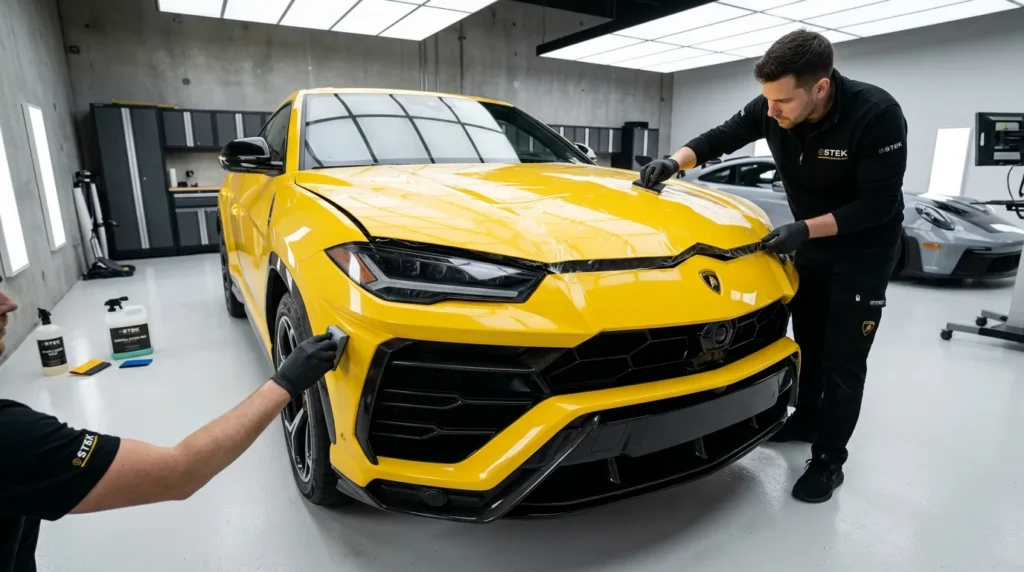
That construction difference shapes the rest of the Liquid PPF vs Film PPF comparison.
What Is Traditional Film PPF?
Traditional Paint Protection Film is a flexible sheet applied over vehicle body panels.
Modern automotive PPF is commonly made from thermoplastic polyurethane, often shortened to TPU.
STEK’s Paint Protection Film line includes clear, matte, colored, and thicker impact-focused films.
STEK DYNOshield is a clear PPF with a hydrophobic and self-healing topcoat.
STEK DYNOmight uses a thicker TPU base layer and is listed by STEK at 10 mil thickness for vehicles exposed to harder use.
Film PPF creates a sacrificial layer.
That means debris contacts the film before reaching the painted surface underneath.
No film can prevent every type of damage. A hard impact or sharp object can still puncture PPF and damage the panel beneath it. Film PPF is meant to reduce the chance of common road wear reaching the paint.
For drivers who care about chips and impact-related damage, that physical sheet is the biggest point in favor of film PPF.
What Is Liquid PPF?
Liquid PPF is applied in liquid form and cures on the vehicle.
Unlike traditional film, there is no precut sheet being laid across a hood, fender, bumper, or door.
This can produce a surface without conventional film seams or edges.
Some liquid PPF manufacturers also advertise self-healing, chemical resistance, UV resistance, and impact resistance.
Opti-Coat describes its Opti-Shield Liquid PPF as a self-healing protective layer with customizable thickness.
P1 Coatings describes its system as removable spray-applied protection that can also provide a paint-like appearance.
Those examples show why Liquid PPF vs Film PPF is not as simple as comparing “liquid” against one universal product.
You need to know which liquid system is being quoted.
Ask for:
- Manufacturer
- Product name
- Finished thickness
- Number of layers
- Removal method
- Warranty
- Self-healing properties
- Chemical resistance
- Impact testing information
- Repair process if one panel becomes damaged
Those details tell you far more than the phrase “liquid PPF” alone.
Liquid PPF vs Film PPF for Rock Chips
For many car owners, this is the deciding factor.
Liquid PPF vs Film PPF for rock-chip protection favors traditional film PPF when a thick physical barrier is the goal.
STEK lists DYNOmight at 10 mils thick and describes the film as suited to higher-impact use. Its standard DYNOshield PPF is also a TPU film designed to take road wear before it reaches vehicle paint.
That physical thickness gives debris material to strike before reaching the surface below.
This is why PPF is commonly installed on:
- Front bumpers
- Hoods
- Front fenders
- Mirror caps
- Rocker panels
- Headlights
- Lower doors
- Rear impact areas
A liquid PPF system can provide physical resistance of its own, but you should compare the actual cured thickness and manufacturer testing rather than assuming it performs the same as a TPU sheet.
What About Highway Driving?
Film PPF makes a strong case for vehicles that regularly travel at highway speeds.
Road debris can strike a front bumper, hood, mirrors, and fenders repeatedly.
Drivers commuting between Miami, FL, Davie, FL, and other parts of Broward County, FL or Miami-Dade County, FL may want to place the greatest protection on those forward-facing areas.
If rock-chip protection is your main reason for shopping, traditional film PPF is the safer starting point for the conversation.
Liquid PPF vs Film PPF for Scratches
The Liquid PPF vs Film PPF scratch comparison is more complicated.
Both categories can include self-healing products.
STEK’s DYNOseries PPF uses a self-healing topcoat. Minor marks in the film can respond to heat depending on the product and severity of the mark.
Opti-Coat also describes its liquid PPF product as self-healing.
That means “self-healing” alone does not tell you which product protects better.
You need to look at what sits underneath the self-healing surface.
With film PPF, there is a TPU sheet beneath the topcoat.
With liquid PPF, the thickness and chemistry depend on the system being installed.
Neither should be treated as scratch-proof.
Deep scratches can pass through protective material. Sharp objects can still cause damage.
Think of self-healing as help with suitable surface-level film marks, not permission to treat the vehicle carelessly.
Liquid PPF vs Film PPF Thickness
Thickness is one of the largest differences in Liquid PPF vs Film PPF.
Traditional film comes with a manufacturer-specified construction and thickness.
STEK lists DYNOmight at 10 mils and says it uses a TPU layer that is 25 percent thicker than its DYNOshield film.
That gives a vehicle owner a measurable physical sheet covering the panel.
Liquid systems vary.
Opti-Coat states that the thickness of its Liquid PPF can be adjusted during professional installation.
Spray-applied peelable systems can also use multiple applied layers to build the finished coating.
This makes direct comparison difficult unless both installers tell you exactly what will be applied.
Do not compare two protection packages solely because both use the letters “PPF.”
Ask what the finished protective layer actually consists of.
Liquid PPF vs Film PPF for Seamless Coverage
Liquid PPF has one clear attraction: there are no conventional sheet-film edges across a panel.
Because the material is applied in liquid form, it can create a continuous sprayed or applied surface.
That may appeal to owners who are very sensitive to visible seams.
Film PPF can still look very clean when installed properly.
Professional installers may wrap suitable edges where panel construction allows it, and vehicle-specific patterns can help produce consistent coverage.
Some areas cannot or should not have every edge wrapped. Panel construction, access, sensors, trim, badges, and body geometry can affect how film is installed.
If nearly invisible edges are your biggest concern, ask an installer to show you completed vehicles before choosing.
Liquid PPF vs Film PPF Removal
Removal is another area where Liquid PPF vs Film PPF differs.
Traditional PPF is removed as a sheet by a trained installer.
The film is warmed and pulled from the panel using a controlled technique intended to reduce stress on the surface below.
A sprayable or liquid PPF product may have a very different removal process.
Some systems are designed to peel.
Others may require manufacturer-specific methods.
That means you should ask about removal before installation, not years afterward.
Questions to ask include:
- Is the product designed to be removable?
- How is it removed?
- Can one damaged panel be redone?
- Does removal require sanding or polishing?
- What happens if the vehicle has repainted panels?
- Is removal covered by any warranty?
- Who should perform the removal?
Film PPF has a long-established panel-by-panel removal model, which can be appealing if future replacement is part of your plan.
Liquid PPF vs Film PPF Appearance
Both systems can produce a clean appearance when installed correctly.
Traditional film PPF can be clear, matte, gloss, colored, or patterned.
305 Auto Customs installs both traditional clear Paint Protection Film and Color PPF.
That means film PPF does not have to leave the vehicle looking exactly as it did before.
Clear film can retain the original paint color.
Matte film can change how gloss paint appears.
Color PPF can replace the visible body color while retaining PPF-style film coverage.
Liquid systems can also be clear or colored depending on the manufacturer.
P1 Coatings, for instance, markets its sprayable system for both clear protection and removable color changes.
Appearance is therefore less about Liquid PPF vs Film PPF as categories and more about the exact product you select.
Film PPF Self-Healing Properties
One reason modern film PPF has become popular is the self-healing topcoat available on certain products.
STEK describes DYNOshield as self-healing and hydrophobic.
This means suitable fine marks in the top layer can respond to heat.
Do not confuse this with the film rebuilding itself after a puncture.
If road debris cuts through the PPF, that section may need repair or replacement.
Self-healing works within the limits of the film’s topcoat.
This distinction matters when comparing Liquid PPF vs Film PPF because both may use self-healing language in product descriptions.
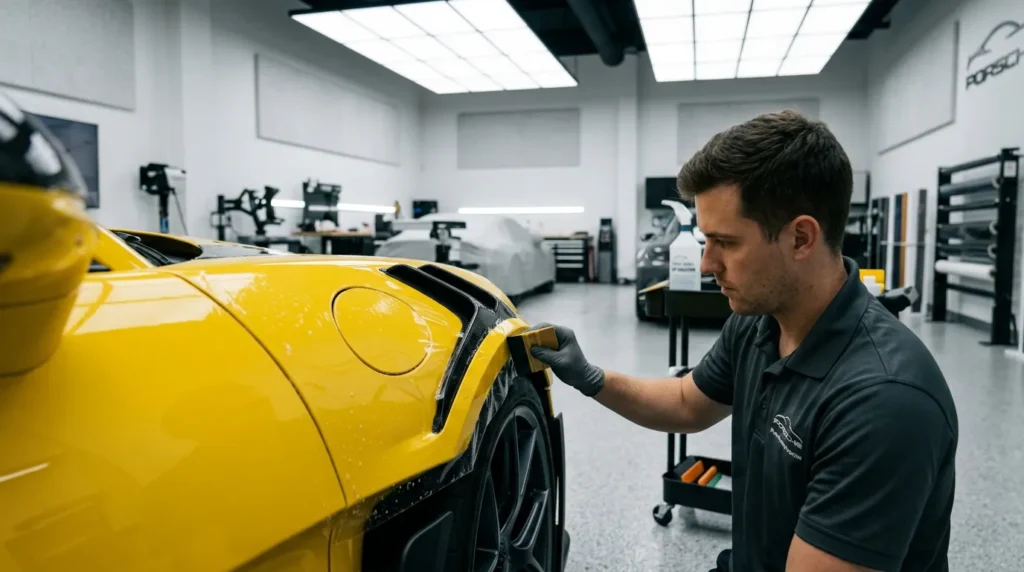
Ask the installer what the manufacturer means by self-healing and what types of marks are covered by that claim.
Is Liquid PPF the Same as Ceramic Coating?
No.
Liquid PPF should not automatically be treated as another name for ceramic coating.
Opti-Coat itself sells Liquid PPF and ceramic coatings as separate product categories. Its Liquid PPF uses a self-healing resin system designed to provide a thicker protective layer, while its ceramic coatings focus on properties such as gloss, chemical resistance, surface behavior, and easier maintenance.
305 Auto Customs also treats ceramic coating and traditional PPF as different services.
The shop uses Malbor Coatings for ceramic coating and STEK and PURE PPF for film protection.
Ceramic coating is a good conversation when you care about:
- Water behavior
- Easier washing
- Gloss
- Slickness
- Surface contamination
Film PPF is the better conversation when your concern centers on:
- Rock chips
- Road debris
- Physical film coverage
- High-impact areas
- Sacrificial protection over paint
Liquid PPF sits somewhere between those categories depending on the product.
That is why the manufacturer’s product data matters.
Where Film PPF Makes the Most Sense
Traditional film PPF makes the most sense when physical impact protection is high on your list.
Consider it for a vehicle that:
- Sees frequent highway miles
- Is driven every day
- Has expensive or difficult-to-match paint
- Frequently travels behind other vehicles
- Visits track events
- Travels on roads with loose debris
- Has wide rear fenders that collect road impact
- Has low rocker panels
- Is a luxury, exotic, collector, or performance vehicle
- Is new and you want to protect the existing finish early
Film PPF is also useful because coverage can be adjusted.
You do not need to cover the entire vehicle to protect common impact areas.
Partial Front vs Full Front vs Full Vehicle PPF
When Liquid PPF vs Film PPF leads you toward traditional film, the next decision is how much of the vehicle to cover.
Partial Front PPF
Partial-front coverage concentrates film on portions of the forward-facing panels.
It may include areas of the hood and fenders along with the front bumper depending on the package.
This gives road-facing areas some film protection while leaving more of the original paint uncovered.
Full Front PPF
A full-front package can cover areas such as:
- Front bumper
- Full hood
- Full front fenders
- Mirror caps
- Headlights
STEK identifies full-front coverage as a common PPF package because these surfaces receive frequent road exposure.
305 Auto Customs can explain its current coverage packages and which panels are included.
Full Vehicle PPF
Full-vehicle PPF extends film across most or all applicable painted body panels.
This option is worth considering when uniform film coverage matters more than focusing solely on the front impact zone.
Full-body coverage can appeal to exotic-car owners, Tesla owners, luxury-car owners, collectors, and people who want a film layer across the vehicle rather than selected panels.
Call (305) 788-9933 to discuss current coverage choices instead of relying on a generic package description.
Color PPF as Another Film Option
Liquid PPF vs Film PPF does not have to mean choosing between clear products.
Film PPF can change the appearance of a vehicle too.
305 Auto Customs offers Color PPF for drivers who want a different color or finish along with film coverage.
Color PPF can make sense when you want to:
- Change the vehicle color
- Move from gloss to another finish
- Cover the original color
- Add PPF-style protection at the same time
- Create a different look without repainting
This gives traditional film another advantage for owners who want both styling and surface protection.
Rather than paying for a color change and then deciding how to protect it, Color PPF can address both goals with one film system.
Choosing PPF for South Florida Driving
Liquid PPF vs Film PPF should also account for how and where you drive.
A garage-kept weekend vehicle in Miami, FL has different exposure from a daily commuter traveling across Miami-Dade County, FL.
A vehicle traveling regularly through Broward County, FL may spend more time on highways than one driven only for short neighborhood trips in Davie, FL.
Think about:
- Annual mileage
- Highway use
- Where the vehicle is parked
- Road construction along regular routes
- How close you tend to follow traffic
- Whether the vehicle visits track events
- Whether it is a daily driver
- Whether paint condition matters heavily to you
- How long you plan to keep the vehicle
For heavy road exposure, film PPF gives you the more substantial physical barrier.
For an owner focused more on seamless appearance, chemical resistance, surface-level scratches, and a spray-applied finish, a properly documented liquid PPF system may deserve consideration.
Why PPF Installation Matters
The product is only part of Liquid PPF vs Film PPF.
Installation affects the finished result.
Traditional PPF requires careful surface preparation, film placement, edge work, trimming or pattern fitting, and inspection.
305 Auto Customs is STEK certified and a STEK vendor. The shop installs STEK and PURE PPF and carries warranties on its products and services.
Before booking PPF, ask:
- Which film will be installed?
- What is its thickness?
- What does the manufacturer warranty cover?
- Which panels are included?
- Are applicable edges wrapped?
- How should the vehicle be washed?
- What happens if one panel of PPF becomes damaged?
- How is old film removed?
- Can ceramic coating be applied over the film?
- Is Color PPF available if you want to change the appearance?
Clear answers make it easier to compare protection packages without relying on marketing terms alone.
Liquid PPF vs Film PPF: Which Actually Protects Better?
If physical impact protection is the deciding factor, traditional film PPF is the stronger choice.
The reason is straightforward.
Film PPF places a measurable TPU sheet between road debris and the painted surface. STEK offers conventional self-healing PPF along with thicker products intended for harder impact exposure.
Liquid PPF can offer features that traditional film does not handle in exactly the same way, including an edge-free cured surface. Certain professional liquid systems also advertise self-healing behavior, chemical resistance, UV resistance, and impact resistance.
The problem with declaring every liquid PPF product equal is that the category includes different chemistries and application methods.
One liquid product may be a self-healing resin system.
Another may be sprayable peelable paint.
Their finished thickness and physical properties may differ.
So when comparing Liquid PPF vs Film PPF, do not ask only which category sounds newer.
Ask what is being installed, how thick it is, how it handles impacts, how it is repaired, how it is removed, and what warranty backs it.
For drivers whose first concern is rock chips and road debris, conventional TPU film remains the easier protection choice to evaluate.
Liquid PPF vs Film PPF FAQs
1. Is Liquid PPF vs Film PPF better for rock chips?
Film PPF is generally the stronger choice when rock-chip protection is the main goal because it places a manufactured TPU sheet over the paint. STEK offers film products with stated thicknesses, including DYNOmight at 10 mils for harder-use applications. Liquid PPF impact resistance varies by product, so compare manufacturer specifications before choosing.
2. Is liquid PPF just ceramic coating?
No. Some manufacturers sell liquid PPF as a separate category from ceramic coating. Opti-Coat, for instance, lists its Opti-Shield Liquid PPF separately from its SiC ceramic coatings. Ask for the exact product name and chemistry rather than assuming every liquid-applied protection product is the same.
3. Can liquid PPF self-heal scratches?
Certain liquid PPF systems are marketed with self-healing properties. Opti-Coat describes Opti-Shield Liquid PPF as self-healing. Traditional film PPF can also have self-healing topcoats. STEK lists several of its TPU films as self-healing. Neither type should be considered immune to deep cuts or severe damage.
4. Is film PPF removable?
Yes. Traditional Paint Protection Film is designed to be removable from suitable automotive surfaces using the proper process. Removal should be performed by someone familiar with PPF, especially when the vehicle has older paint, refinished panels, or previous body repairs.
5. Does film PPF have visible edges?
Film PPF can have edges depending on the panel, pattern, and installation method. Some suitable edges can be wrapped. Liquid PPF can produce a surface without conventional sheet-film seams. If edge visibility concerns you, look at completed vehicles from the installer before deciding.
6. Can I get Color PPF instead of clear film?
Yes. 305 Auto Customs offers Color PPF for customers who want to change exterior color or finish while adding PPF coverage. Current colors and films can change, so call the shop to see available choices.
7. Where can I get film PPF in Miami, FL?
Call 305 Auto Customs at (305) 788-9933 or use the contact form to discuss PPF coverage for your vehicle. The shop is located at 19597 NE 10th Ave, Bay F, Building 6, Miami, FL 33179 and serves drivers in Miami, FL, Davie, FL, Broward County, FL, and Miami-Dade County, FL.
Contact 305 Auto Customs
Liquid PPF vs Film PPF becomes easier to compare once you decide what kind of damage concerns you most.
If rock chips, highway debris, and physical impacts are at the top of the list, traditional film PPF provides a substantial TPU layer over covered vehicle surfaces.
If seamless coverage without conventional film edges interests you, ask about the exact liquid PPF product being considered and compare its cured thickness, impact properties, repair method, removal process, and warranty against traditional film.
305 Auto Customs installs Paint Protection Film using STEK and PURE PPF products and offers coverage choices for South Florida drivers.
You can also ask about:
Call 305 Auto Customs at (305) 788-9933 or visit the contact page to schedule an appointment.
305 Auto Customs
19597 NE 10th Ave
Bay F, Building 6
Miami, FL 33179
Business Hours
Monday through Friday: 8 AM to 6 PM
Saturday and Sunday: 10 AM to 5 PM
305 Auto Customs serves drivers in Miami, FL, Davie, FL, Broward County, FL, and Miami-Dade County, FL.
Sources
- Paint Protection Film
Publisher: STEK USA
Publication Date: Page does not list a publication date
URL: https://www.stek-usa.com/paint-protection-film/
Used for information about TPU-based PPF, self-healing topcoats, hydrophobic film, coverage choices, film warranties, and STEK PPF construction. - DYNOmight Paint Protection Film
Publisher: STEK USA
Publication Date: Page does not list a publication date
URL: https://www.stek-usa.com/paint-protection-film/dynomight/
Used for manufacturer information about 10 mil PPF thickness, the thicker TPU layer, self-healing properties, and higher-impact applications. - Opti-Coat Ceramic Coatings & Liquid PPF
Publisher: Optimum Polymer Technologies / Opti-Coat
Publication Date: Page does not list a publication date
URL: https://opticoat.com/pages/ceramic-coatings-liquid-ppf
Used for information about Opti-Shield Liquid PPF, self-healing resin, SiC protection, customizable layer thickness, seamless coverage, impact resistance, and the distinction between Liquid PPF and ceramic coating. - P1 Coatings Liquid PPF and Peelable Paint
Publisher: P1 Coatings
Publication Date: Page does not list a publication date
URL: https://www.p1coatings.com/
Used to show that spray-applied liquid PPF systems can differ from resin-style liquid protection and may use removable peelable coating technology. - Paint Protection Film
Publisher: 305 Auto Customs
Publication Date: Page does not list a publication date
URL: https://305autocustomsfl.com/services/paint-protection-film/
Used for information about STEK and PURE PPF services, coverage choices, warranty-backed installation, and South Florida service areas. - Color PPF
Publisher: 305 Auto Customs
Publication Date: Page does not list a publication date
URL: https://305autocustomsfl.com/services/color-ppf/
Used for information about combining a color or finish change with Paint Protection Film coverage. - Ceramic Coating
Publisher: 305 Auto Customs
Publication Date: Page does not list a publication date
URL: https://305autocustomsfl.com/services/ceramic-coating/
Used for the comparison between ceramic coating and film-based Paint Protection Film. - 305 Auto Customs
Publisher: 305 Auto Customs
Publication Date: Page does not list a publication date
URL: https://305autocustomsfl.com/
Used for business services, STEK and PURE PPF information, warranties, and service-area information. - Contact 305 Auto Customs
Publisher: 305 Auto Customs
Publication Date: Page does not list a publication date
URL: https://305autocustomsfl.com/contact-us/
Used for appointment and contact information.
Is Ceramic Coating Worth It for Your Car in Davie, FL? | 305 Auto Customs
Is ceramic coating worth it for your car in Davie, FL? Learn how ceramic coating helps keep paint cleaner, adds gloss, and makes car care easier in South Florida.
Product Brand: Malbor Coatings
5
Pros
- Is ceramic coating worth it for your car in Davie, FL? Learn how ceramic coating helps keep paint cleaner, adds gloss, and makes car care easier in South Florida.
